Showing posts with label europe. Show all posts

Friday, November 16, 2007

Bruges


Places I would like to visit in Europe, in no order:
2. Bruges
I first heard about Bruges a couple of years ago when I read the novel by George Rodenbach, Bruges-la-Morte. The Symbolist novel is heavily colored with languid prose about a widower's grief. It prominently features the city and the city's decaying repose.


History:
Bruges (Brugge) was founded in the 9th century by Vikings who settled here at the end of the little river 'de Reie'. The name Bruges is probably derived from the old-Scandinavian word 'Brygga', which means 'harbor, or mooring place'. Because of the proximity of the North Sea, the settlement very quickly became an important international harbor. A sea-arm, called the Zwin, connected Bruges with the North Sea. The young settlement acquired city rights as early as the 12th century. At that time a first protective wall was built around Bruges.

Already in the 13th century Bruges was an important international trading center. Traders from all over the then known world came to the city to sell their products to each other and to buy Flemish cloth, a internationally acclaimed textile product, produced in different Flemish cities (e.g. Gent). In the early 14th century Bruges was the scene of political unrest between the citizens and the count of Flanders. Because of this unrest the French king tried to annex the county of Flanders, but the population managed to kick out the French garisson on May the 18th 1302. Later the Flemish army beat the French army in the 'Battle of the Golden Spurs' on July the 11th in the Flemish city of Kortrijk.

In the 14th century Bruges turned also into an international financial and trading center. Several countries had their own representation in Bruges: the Italians, the Germans, the Scottish, the Spanish made the city into a true European center where different languages could be heard and where the most exotic products could be found.

The decline of Bruges' wealth started in the 15th century : the unstoppable silting up of the Zwin, the competition with the bigger harbor of Antwerp and the crisis in the cloth industry resulted in less commercial activity. The crisis, however, was not immediately noticable. Bruges continued to construct splendid late-gothic buildings and churches, and the Flemish painting school (with e.g. the brothers Van Eyck and Hans Memling ) started to flourish as never before.
By the end of the 16th century the former glory was only a memory and Bruges slipped into a wintersleep that took several centuries. New textile industries were introduced in the 19th century, but to no avail. In the middle of the 1800's Brugge was the poorest city in Belgium.


Wednesday, November 07, 2007

Dubrovnik


Places I would like to visit in Europe, in no order:

1. Dubrovnik


picture #1 from this site:
picture #2 from this site:
http://www.agencija-vangogh.si/eng/dubrovnik.asp

Dubrovnik is an historic city on the Adriatic Sea coast in the extreme south of Croatia, positioned at the terminal end of the Isthmus of Dubrovnik. It is a seaport and the centre of Dubrovnik-Neretva county.

Since 1979, the historic centre of Dubrovnik has been included in the UNESCO list of World Heritage Sites.

The prosperity of the city of Dubrovnik has always been based on maritime trade. In the Middle Ages, as the Republic of Ragusa, it became the only eastern Adriatic city-state to rival Venice. Supported by its wealth and skilled diplomacy, the city achieved a remarkable level of development, particularly during the 15th and 16th centuries. Ragusa was one of the centres of the development of the Croatian language and literature, home to many notable poets, playwrights, painters, mathematicians, physicists and other scholars.

from Wiki.


and from an article in the Smithsonian Magazine.

History resides everywhere here. “I was a child during the Italian occupation of parts of Croatia in World War II, and I still remember when the Partisans won that war,” the 71-yearold helmsman said. “Today, Tito’s communism seems to have vanished in the wind. I think it’s easier for people who have a past to put their lives in perspective.”

“In many respects, the 4,000 people living within Dubrovnik’s old city walls function as they did hundreds of years ago,” said Nikola Obuljen, 64, president of Dubrovnik’s city council, as he ambled across a limestone thoroughfare polished by centuries of foot traffic. “Venice has palazzos and the RialtoBridge, but Dubrovnik is a functioning Renaissance city where people live in the houses and shop at the markets.”

I first came to Dubrovnik in 1999 as a visitor searching for an eye in the Balkan storm. Kosovo then was in flames; Belgrade under siege. Bosnia remained intact only by force of international fiat. I needed a respite from Sarajevo, where, working as a journalism instructor, I happened to live a mile from a mass grave. That devastated city was recovering from the war that had ended there only the previous year. But as I drove south from Sarajevo toward Dalmatia, Bosnia’s once-fertile farmland offered only a succession of ghostly hamlets ethnically cleansed of inhabitants. Mostar, the last major stop before the Dinaric Alps, had been reduced to rubble. The Ottoman bridge that for centuries had spanned the Neretva River was destroyed, a casualty of the malignant xenophobia then infecting Bosnia and Herzegovina.

But as I traveled down the coastal highway beyond the mountains, the air began to warm, scenes of destruction grew less frequent and police actually began to smile. At the village of Ston, gateway to the Peljesac Peninsula, I entered the old, 530-square-mile Republic of Dubrovnik, which enjoyed an independent status for a millennium, to 1808. For the next hour, I meandered past fishing villages nestled beneath foothills verdant with vineyards. In the distance, an archipelago seemed to float in the mist. And then it appeared in the twilight: a walled city rising from the rocky coast like an Adriatic Camelot.

Wednesday, August 08, 2007

ghastly, indeed


More clues about Europe before the World Wars, about the maps above: 1. Europe roughly after the Congress of Vienna 2. The corresponding language groups. From this website.

Congress of Vienna, on October 2, 1814


"What struck them first was the light. Sixteen thousand candles and thirty-two chandeliers lit up two ballrooms in the imperial palace, where the glass windowpanes had been replaced with mirrors, redoubling the splendor.

Geographically, the problem at Vienna was roughly the same as the one facing the Allies at Potsdam in 1945. Russia, which bore the brunt of the war against Napoleon, had marched its armies across Europe and was now effectively in control of Poland and much of Prussia. Alexander, who had a messianic dream of restoring Poland to the map as a kingdom under his control, refused to give back the parts of Poland that had formerly belonged to Prussia. As a result, Prussia sought compensation to the west, demanding to annex the independent kingdom of Saxony. Austria, meanwhile, under the wily conservative Metternich, hoped to maintain a balance of power, to rein in Alexander's ambitions, and to keep Prussia from dominating the smaller German states. It was a thoroughly unedifying spectacle, in which the great powers swapped cities and provinces like horse-traders, while the claims of small nations were ruthlessly ignored."


"Indeed, the Walser tone, hovering between beatific quietism and a burlesque of conventionality, is detectable in the immortal reply he gave a man who visited him at an asylum and asked about his writing: 'I am not here to write, but to be mad.'"


"Nancy Cunard paid a high price for her nonconformity. She was disinherited, arrested, beaten, institutionalized and eventually declared insane. Her legacy includes her refusal to regret, or attempt to explain, any of it.

Cunard was like "some invention, ghastly or not, of her own.... She didn't fit anywhere." That inconsistency or "passionate inconstancy," as William Carlos Williams called it, consisted of, as one male friend described it, "baffling contradictions"--she was passionate but unromantic, loyal but unforgiving, unconventional but fastidious, emotional but unsentimental, hedonistic but anorexic. Huxley summed her up as "one of those women who have the temperament of a man." Ghastly indeed."


"Characters die from humiliation in Max Ophuls or, to put it cruelly, they die from frustration. {…}Absorbed totally in passion, nothing else exists, as Stendhal says again, and frustrated passion crystallizes like crazy, becomes obsession, and dominates us totally. {…}Passion makes us prisoners first, then criminals."

Then, in the interest of getting away......

"The problems started when I put down my fork. Unable to find it among the plates, wine glasses, and baskets of bread, I resorted to shovelling steak into my mouth by hand - but I didn't worry about offending the well-mannered Parisians seated nearby. They couldn't see a thing."

Wednesday, July 18, 2007

Europe

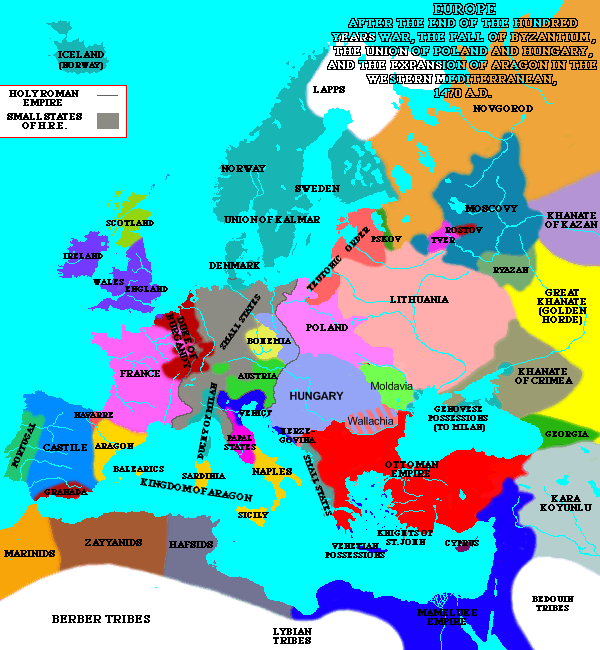
I found it interesting to see how much Europe has changed in the years. See this map from 1470? See how huge Lithuania is and how present day Spain is actually four "kingdoms": Castille, Granda, Navarre and Aragon, yet there is no mention of the Basque country.

map from Wiki

http://upload.wikimedia.org/wikipedia/commons/4/4f/Europe_in_1470.png


Now here's a map of Europe right before WWI. No Lithuania in sight and Spain has been unified, and Austria-Hungary dominates Europe, but we know how that changes. Time to hit the history books to see how this all comes about.