Showing posts with label new yorker. Show all posts

Thursday, February 07, 2008

hypnopompic


picture 1: Color photos from WWI-http://www.worldwaronecolorphotos.com/
picture 2: Cafe in Vienna, 1971


It was the Austrian sketch-writer and habitué of Vienna's Café Central, Alfred Polgar, who perhaps best captured the essence of the literary café when he described it as "a place where people want to be alone, but need company to do so". Since the first European coffee house opened in Venice in 1645, artists and writers have adopted cafés as their unofficial workplaces - libraries in which they can eat, drink, smoke and gossip at the same time as working on the latest draft and sharing ideas.

Today, the decline of a true café society is to be mourned. One can hardly imagine Alfred Jarry's (author of Ubu Roi) pick-up line working in Starbucks. Spotting a pretty girl from his vantage point at the bar in Paris's La Closerie des Lilas, he approached her table, fired a shot into the mirror behind her with his gun and said suavely, "Maintenant que la glace est rompue, causons." ("Now the ice is broken, let's talk.") link

........................

The Muslims came to Europe, he writes, as “the forward wave of civilization that was, by comparison with that of its enemies, an organic marvel of coordinated kingdoms, cultures, and technologies in service of a politico-cultural agenda incomparably superior” to that of the primitive people they encountered there. They did Europe a favor by invading. This is not a new idea, but Lewis takes it further: he clearly regrets that the Arabs did not go on to conquer the rest of Europe. The halting of their advance was instrumental, he writes, in creating “an economically retarded, balkanized, and fratricidal Europe that . . . made virtues out of hereditary aristocracy, persecutory religious intolerance, cultural particularism, and perpetual war.” It was “one of the most significant losses in world history and certainly the most consequential since the fall of the Roman Empire.” link

Friday, January 25, 2008

One Grump's Search for the Happiest Places in the World


When I read the above headline, I knew it referred to me: I am a grump, although a well-read grump. The first picture is taken from a slideshow about Lee Miller in the 1/21/2008 issue of the New Yorker which accompanied a very interesting article but it is not available online. The second picture is Weldon Kees reading in San Francisco.

Little reads of the week:

The days get longer. It was a long time ago.
And I have come to that point in the turning of the path
Where peaks are infinite--horn-shaped and scaly, choked with

thorns.
But even here, I know our work was worth the cost.
What we have brought to pass, no one can take away.
Life offers up no miracles, unfortunately, and needs assistance.
Nothing will be the same as once it was,
I tell myself.--It's dark here on the peak, and keeps on getting
darker.
It seems I am experiencing a kind of ecstasy.
Was it sunlight on the waves that day? The night comes down.
And now the water seems remote, unreal, and perhaps it is.
-Weldon Kees A Distance From The Sea


By all accounts, Balenciaga -- severe, uncompromising, taciturn -- is couture's Soup Nazi. As his friend and Vogue's fashion editor, the high-born and high-minded Bettina Ballard, wrote, "His life is his work...It rarely seems to give him a sense of fulfillment, as it never reaches the perfection he desires. Balenciaga's art emerged from his sympathy with women. He knew, for instance, that he had three generations of women to dress, and so always had some older models. Ernestine Carter, fashion editor of The Times of London, was spot-on in her evocation of his favorite model and the muse for many of his early masterpieces, the notoriously unpleasant Colette (not the writer): "her Dracula walk, her big head low like a bull ready to charge, her shoulders hunched down,...and a look of almost violent hatred on her face." She wouldn't have fit in at the House of Dior, where woman was ornament, but she was extremely useful to Balenciaga's customers: "Any woman could wear Colette's clothes -- one of those tricks of proportion."


From the Persian Gulf to the Arctic Circle, Weiner discovers that happiness blooms where we least expect it. Who knew that the long, dark Icelandic winter gives rise to a magical, communal culture that has done away with envy and sobriety? Or that the Thais so prize "fun" that their government has created a Gross Domestic Happiness Index to ensure they get enough of it? Or that Moldovans are miserable because they "derive more pleasure from their neighbor's failure than their own success"? Or that the wealthy citizens of Qatar lead pampered, joyless lives in a "gilded sandbox" while the poor citizens of Bhutan are cheerfully obsessed with archery tournaments, penis statues and feeding marijuana to their fat (and presumably happy) pigs?

Saturday, January 19, 2008

Anna Akhmatova


I drink to the wreck of our life together
And the pain of living alone.
I drink to the loneliness we shared-
My dear, I drink to you.

I drink to the trick of a mouth that betrayed me,
To the eyes and the look that lied.
I drink to the terrible world we inhabit
And to god, who never replied.

- Anna Akhmatova trans. by Paul Schmidt
from a found New Yorker, November 6, 2006

Monday, December 24, 2007

Museums of Disasters, II


picture from this site: http://www.kakarigi.net/manu/vijecnic.htm

Museum of genetic catastrophe

“I understand that the idea of bringing something dead back to life is fundamentally frightening,” he went on. “It’s a power that science has come to possess and it makes us queasy, and it should. But there are many viruses that are more dangerous than these—more infectious, far riskier to work with, and less potentially useful.’’


Museum of an extinct race

"The man [Dervis Korkut] so determined to protect a Jewish book was a scion of a prosperus, highly regarded family of Muslim intellectuals, famous for producing judges of Islamic law. He studied theology at Istanbul University and Near Eastern Languages at the Sorbonne. He spoke at least ten languages and served as the Bosnian National Museum’s chief librarian."

Wednesday, November 14, 2007

peripeteia


picture #1- I don't remember where I found this-
picture #2- from this great website: http://curiousexpeditions.org/2007/09/a_librophiliacs_love_letter_1.html


"I had a certain talent for friendship, but I never had any friends, either because they simply didn't turn up, or because the friendship I had imagined was an error of my dreams. I've always lived alone, and ever more alone as I become more self-aware. "
-Fernando Pessoa Book of Disquiet

"…recordings seemed to become a kind of phantasmagoria, a virtual reality that threatened to replace concert life." -Alex Ross (New Yorker)

"Le Chants de Maldoror is full of the familiar ferocities and blasphemies, the familiar somber confessions of uncommon and magnificent sins, carried, however, to unprecedented lengths by a young writer who evidently felt that his predecessors had set him a high standard to surpass; but the images of his nightmares and tirades have that peculiar phantasmagoric quality which was to be characteristic of Symbolism." -Edmund Wilson Axel's Castle

Tuesday, October 23, 2007

more amusing muses


The Surrealists' Muse, by Francine Du Plessix Gray, from the New Yorker

“…Marie-Laure [de Noailles] met the last great love of her life, a Spanish painter named Oscar Dominguez, one of the few heterosexuals she ever took up with. Dominguez, four years older than she, was born in the Canary Islands and, after moving to Paris, hung out on the fringes of the Surrealist movement. A man whose face resembled that of an Easter Island statue, Dominguez was a heavy drinker given to outrageous behavior- he would shout out “My penis is hard as gold” at the dinner table. According to a friend, the couple looked like the union of a transvestite Louis XVI and a Cro-Magnon man, and even at formal parties they pawed at each other like teenagers.”


“…there was something subversive about the institution of the fairy tale in France during the 1690s, for it enabled writers to create a dialogue about norms, manners, and power that evaded court censorship and freed the fantasy of the writers and readers, while at the same time paying tribute to the French code of civilité and the majesty of the aristocracy. Once certain discursive paradigms and conventions were established, a writer could demonstrate his of her “genius” by rearranging, expanding, deepening, and playing with the known functions of a genre that, by 1715, had already formed a type of canon…”

-Jack Zipes from the Introduction, Spells of Enchantment

Thursday, October 04, 2007

synchronicity and blood


The first photo from this photographer- (how I feel sometimes)
http://www.chantalmichel.ch/fotografie/index.html


In the past week I had two dreams of blood. One of the dreams I had cut myself and felt the blood run down my hand. The sight of the blood made my stomach knot up so tightly that it woke me up and I felt nauseous. The next day at work, I had two bloody noses.
The other dream I had: a basin that was overflowing with blood.

I remember reading about the connection to blood and perfume; it was in a book titled, Scent, by Annick Le Guérer: "the power of perfume have centered upon its similarity to magical potions, its association with the mythologies of vital fluids such as sap and blood". There is a whole chapter on Blood, Incense and Ritual.

I looked for a blood in contemporary perfumes, the closest thing I found was with blood orange: Maitre Parfumeur et Gantier Sanguine Muskissime, reviewed here.

Sanguine is one of the four humors that relate to blood. The other three are: Choleric, Melancholic, and Phlegmatic.

The Sanguine temperament, according to Wiki:

Sanguine indicates the personality of an individual with the temperament of blood, the season of spring (wet and hot), and the element of air. A person who is sanguine is generally optimistic, cheerful, confident, popular, and fun-loving. He/She can be day dreamy and off-task to the point of not accomplishing anything and can be impulsive, possibly acting on whims in an unpredictable fashion. Sanguines usually have a lot of energy, but have a problem finding a way to direct the energy. This also describes the manic phase of a bipolar disorder.


I'm more of a Choleric type, myself.

Some history of the blood orange:

"The Blood, Moro, or Maltese Oranges are very old orange varieties. There is some historical evidence that the blood orange hybrid first appeared in Southern Europe around 1850 and was then brought to North America many decades later by Spanish and Italian immigrants. Commonly know throughout most of the world as "blood," "blood-red" or "blush" oranges, they have a number of other common or regional names."


Last week, within one hour I read two reviews of the same book, not intentionally. One in the New Yorker, the other in Raintaxi (which does not have it available online).
In Her Absence
by Antonio Muñoz Molina, translated from the Spanish by Esther Allen (Other Press)

Mario believes that his wife, Blanca, has disappeared and been replaced by an impostor who is almost identical, only more sensual and tender. Thus begins the story of an unlikely marriage. Mario, guided by the lessons of his working-class origins, values “almost nothing in life more than stability.” But Blanca, privileged and with an “innate” sense of entitlement, has come to feel that their life is one “from which great experiences were absent.” Mario is infatuated with Blanca; Blanca is infatuated with art. As her interest shifts from one trendy artist to another, Mario strives to keep pace. Muñoz Molina layers a subtle satire of artistic hypocrisy with a stirring account of class separation. Mario is entranced by his wife’s “aura of uncertainty” but cannot escape his own self-annihilating caution. “Penury,” he reflects, “makes people fearful and conformist.”


Wednesday, September 19, 2007

season of hoaxes


Why do we fall for hoaxes? Some hoaxes seem too absurd to believe, and yet people believe. Is it the impossibility that we fall for? Perhaps in this life of much-desired security that some event, so improbable enchants us. And perhaps, in this pre-ordained world, that something can escape and exist outside of all expectation? Yet, when the hoax is discovered, oh the wrath. Nevertheless, no one seems to learn from it, and one waits to fall for the next hoax. Below the story of the word that never was, the wine mixer that never existed, the pianist that never played and the story that was never written.


Turn to page 1,850 of the 1975 edition of the New Columbia Encyclopedia and you’ll find an entry for Lillian Virginia Mountweazel, a fountain designer turned photographer who was celebrated for a collection of photographs of rural American mailboxes titled “Flags Up!” Mountweazel, the encyclopedia indicates, was born in Bangs, Ohio, in 1942, only to die “at 31 in an explosion while on assignment for Combustibles magazine.”

If Mountweazel is not a household name, even in fountain-designing or mailbox-photography circles, that is because she never existed."


If indeed Parker’s hundred-point 1921 Pétrus was a fake, such hubris might not be misplaced. Could Rodenstock have become so proficient at making fake wine that his fakes tasted as good as, or even better than, the real thing? When I asked Parker about the bottle, he hastened to say that even the best wine critics are fallible. Yet he reiterated that the bottle was spectacular. “If that was a fake, he should be a mixer,” Parker said. “It was wonderful.”


Fundamental to the burgeoning interest in Hatto was awe that she could be so tirelessly productive during what should have been her retirement. Her exploits seemed even more remarkable after Richard Dyer, then the chief music critic of the Boston Globe, interviewed her in the summer of 2005 and wrote an article that began, “Joyce Hatto must be the greatest living pianist that almost no one has ever heard of.” The next paragraph contained a surprising revelation: “Hatto, now 76, has not played in public in more than 25 years because of an ongoing battle with cancer. She was once told that it is ‘impolite to look ill,’ and after a critic commented adversely on her appearance, she resolved to stop playing concerts.”


The most fascinating aspect of hoaxes is the extent to which they tend to escape the control of their creators, absorbing new accomplices along the way. As McHale observed in a recent interview, literary hoaxes are ''cut loose from their source, or outright lie about it, and so float free, in a certain sense, so that they can be reclaimed further down the line and used for all sorts of unintended purposes."

Wednesday, September 05, 2007

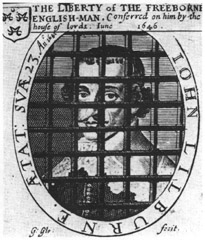
John Lilburne


Who's that writing? John the agitator

"If only John Lilburne were left in the world, then John would quarrel with Lilburne and Lilburne with John" Henry Marten

picture 1 is from this website- a Libertarian who travels the world giving lectures- I'm not a Libertarian, but he does have nice pictures on his website-


From Wikipedia:

John Lilburne (1614?–August 29, 1657 England), also known as Freeborn John.

John Lilburne began in earnest his campaign of agitation for freeborn rights, the rights that all Englishmen are born with, which are different from privileges bestowed by a monarch or a government.

John Lilburne was arrested upon information by an informer acting for The Stationers' Company and brought before the Court of Star Chamber. Instead of being charged with an offense he was asked how he pleaded. John Lilburne demanded to be presented in English with the charges brought against him (much of the written legal work of the time was in Latin). The Court refused Lilburne's request. The court then threw him in prison and again brought him back to court and demanded a plea. Again John Lilburne demanded to know the charges brought against him.

The authorities then resorted to flogging him with a three-thonged whip on his bare back, as he was dragged by his hands tied to the rear of an ox cart from Fleet Prison to the pillory at Westminster. He was then forced to stoop in the pillory where he still managed to campaign against his censors, while distributing more unlicensed literature to the crowds. He was then gagged. Finally he was thrown in prison. He was taken back to the court and again imprisoned.

This began the first in a long series of trials that lasted throughout his life for what John Lilburne called his "freeborn rights". As a result of these trials a growing number of supporters began to call him "Freeborn John" and they even struck a medal in his honor to that effect. It is this trial that has been cited by constitutional jurists and scholars in the United States of America as being one of the historical foundations of the Fifth Amendment to the United States Constitution. It is also cited within the 1966 majority opinion of Miranda v. Arizona by the U.S. Supreme Court.


On the other side, perhaps related, an apartment that costs 45 million dollars? Not even a house, but an apartment in a 201 unit apartment building in New York City-absurd. From the New Yorker

A building like this leaves you two choices: you can resist it or you can yield to it. On one level, there’s something unsettling about the whole thing—is costume-drama luxury the best that our new century has to offer? And what are we to make of the feeding frenzy surrounding it, in an already hypertrophied real-estate market?

Tuesday, August 21, 2007

scent of Vienna?


More stolen pictures: 1. Ernst Haas- Photographer, born in Vienna 1921
2. A photo by Ernst Haas- and yes, that is Marilyn Monroe, from Arthur Miller's The Misfits, 1960


More thoughts on Vienna, I was imagining, what would a perfume inspired by Vienna smell like?

Like Diorella?

"Start with the obvious: Diorella is a profoundly strange perfume. A Frenchman I said this to became very defensive and replied, ''Diorella is a classic!'' Which was not only irrelevant -- it also missed the point entirely. Can you describe Diorella? People say, ''Intensely flowery''; they say, ''Fresh yet weightless''; they say, ''Notes of citrus and ripe fruit'' and blah-blah-blah. O.K., fine. All of this is wrong: what is wonderful about Diorella is that it smells like a new fur coat that has been rubbed with a very creamy mint toothpaste. Not gel. Paste. It is a great, great fragrance. It was created for Dior by the legendary perfumer Edmond Roudnitska in 1972, and it feels like 1932 and 2022 at the same time."


No- Maybe more like Nombre Noir:

"The flower at the core of Nombre Noir was half-way between a rose and a violet, but without a trace of the sweetness of either, set instead against an austere, almost saintly back-ground of cigar-box cedar notes. At the same time, it wasn't dry, and seemed to be glistening with a liquid freshness that made its deep colors glow like a stained-glass window."
-Luca Turin


This scent would follow the end song of the plays and stories of Arthur Schnitzler- Wiener Moderne writer.

"Schnitzler's final stories are, inevitably, elegies for a vanished world. It is surely significant that several of them end in suicide, as if the self-destruction of individuals embodied the disaster of a whole society rushing into oblivion. In the novella "Night Games," a young officer, Lieutenant Wilhelm Kasda—precisely the sort of person Schnitzler would once have satirized—is ruined in a game of baccarat. He has a day to raise the money or his honor as an officer will be lost and suicide his only option. Few writers could hope to equal the intensity with which Schnitzler imagines Kasda's desperation as he begs for money, first from a rich uncle and then from a woman he slept with once and then neglected. When the suicide comes, however, the narration switches to a tragicomic mode that is almost Chekhovian. The uncle, arriving too late with the money, cuts a painfully foolish figure beside the corpse."


Tuesday, August 14, 2007

Hunger

I read it with relish, I started on Sunday and finished this morning (Tues.) on BART, on my way to work. I felt uncomfortable reading it while having breakfast. I felt deranged while reading it at a full cafe in Berkeley on a Monday afternoon. I walked by two or more cafes, filled with Berkeley students studying diligently for the summer semester. When I finished the book, I wondered if all my readings of such depraved characters were going to drive me to lunacy. I guess we will find out, since I do not see myself eliminating such literature from my reading list any time soon.

Here's one excerpt I found when I randomly opened the book, it is tame, comparatively.

"Not a sound came to disturb me-the soft dark had hidden the whole world from me, and buried me in a wonderful peace- only the desolate voice of stillness sounded monotonously in my ear. And the dark monsters out there wanted to pull me to themselves as soon as night came, and they wanted to take me far far over seas and through strange lands where no human being lives. " -Hunger Knut Hamsun

Here's a New Yorker article on Hamsun from December 2005:

"...Isaac Bashevis Singer argued that "the whole modern school of fiction in the twentieth century stems from Hamsun, just as Russian literature in the nineteenth century ‘came out of Gogol’s greatcoat.’ ” In Scandinavia, though, Hamsun meant trouble. During those months in Copenhagen, I occasionally walked into one of the antiquarian bookstores that could be found all over the city’s Latin Quarter. Several times when I asked about Hamsun’s works, the man behind the counter (it was always a man) would shake his head and declare, “He was a traitor!” I’d try to remember the shop so as not to embarrass myself again."

Wednesday, August 08, 2007

ghastly, indeed


More clues about Europe before the World Wars, about the maps above: 1. Europe roughly after the Congress of Vienna 2. The corresponding language groups. From this website.

Congress of Vienna, on October 2, 1814


"What struck them first was the light. Sixteen thousand candles and thirty-two chandeliers lit up two ballrooms in the imperial palace, where the glass windowpanes had been replaced with mirrors, redoubling the splendor.

Geographically, the problem at Vienna was roughly the same as the one facing the Allies at Potsdam in 1945. Russia, which bore the brunt of the war against Napoleon, had marched its armies across Europe and was now effectively in control of Poland and much of Prussia. Alexander, who had a messianic dream of restoring Poland to the map as a kingdom under his control, refused to give back the parts of Poland that had formerly belonged to Prussia. As a result, Prussia sought compensation to the west, demanding to annex the independent kingdom of Saxony. Austria, meanwhile, under the wily conservative Metternich, hoped to maintain a balance of power, to rein in Alexander's ambitions, and to keep Prussia from dominating the smaller German states. It was a thoroughly unedifying spectacle, in which the great powers swapped cities and provinces like horse-traders, while the claims of small nations were ruthlessly ignored."


"Indeed, the Walser tone, hovering between beatific quietism and a burlesque of conventionality, is detectable in the immortal reply he gave a man who visited him at an asylum and asked about his writing: 'I am not here to write, but to be mad.'"


"Nancy Cunard paid a high price for her nonconformity. She was disinherited, arrested, beaten, institutionalized and eventually declared insane. Her legacy includes her refusal to regret, or attempt to explain, any of it.

Cunard was like "some invention, ghastly or not, of her own.... She didn't fit anywhere." That inconsistency or "passionate inconstancy," as William Carlos Williams called it, consisted of, as one male friend described it, "baffling contradictions"--she was passionate but unromantic, loyal but unforgiving, unconventional but fastidious, emotional but unsentimental, hedonistic but anorexic. Huxley summed her up as "one of those women who have the temperament of a man." Ghastly indeed."


"Characters die from humiliation in Max Ophuls or, to put it cruelly, they die from frustration. {…}Absorbed totally in passion, nothing else exists, as Stendhal says again, and frustrated passion crystallizes like crazy, becomes obsession, and dominates us totally. {…}Passion makes us prisoners first, then criminals."

Then, in the interest of getting away......

"The problems started when I put down my fork. Unable to find it among the plates, wine glasses, and baskets of bread, I resorted to shovelling steak into my mouth by hand - but I didn't worry about offending the well-mannered Parisians seated nearby. They couldn't see a thing."

Friday, August 03, 2007

lacuna

Ok- That's it, everyone can packup and leave now.


Interactions like that make me want to move to Belgium and never talk to anyone and never know anyone ever again. And there are some who want to make it seem a lot better than it ever could be:

“I struggled to come to terms with this new knowledge,” Goodall later wrote. She would wake in the night, haunted by the memory of witnessing a female chimpanzee gorging on the flesh of an infant, “her mouth smeared with blood like some grotesque vampire from the legends of childhood.”

Wednesday, July 25, 2007

idle matter

I'm bored, I've been bored for the last month, I do not know why. I am engaged in daily activities which make me feel satisfied, but I feel that I am somehow infected with a taedium vitae. I think I might need take a class, or to change jobs, or move to another country. Today, I thought of some "titles", in attempts to humor myself:

1. Exercises in Tragedy
2. How to Complete the Unspeakable
3. Experiencing Unnecessary Boredom

Then I searched "idle chatter" on google and found this strange thing:


"Why does Tim Hawkinson like to play with himself so much? Why does he goof around with his own body, measuring it and categorizing it? Why does he make such beautiful little things with the detritus that falls from it? Why does he make such charming and amusing things at all?"

and from the New Yorker:

"Weird week. Weird, weird week, passing from alert orange to heavenly white and back to the usual muddle of slush. People keep trying to "gauge public opinion" at this moment of crisis. Fortunately, though, in the past year in New York we've had on hand a machine that can tell you what the world is thinking—that actually listens to the world, reads its mind, and tells you exactly what's up in there. The machine, a Jimmy Neutron assemblage of display monitors and loudspeakers and copper wire, is the brainchild of a Bell Labs statistician named Mark Hansen and a sound designer and artist named Ben Rubin, and for most of the past year you could find it in a loft on the Bowery, where you could drop in on it if you knew it was there. For the past couple of months, though, it has been on loan to the Whitney Museum of American Art, and in a rough week it was a pleasure to sit in the dark and listen."

And just for fun, I searched "colorfields" in the New Yorker and found this:

"At a boozy dinner party that I attended in a New York walkup nearly thirty years ago, a woman announced that she was getting married. Joan Mitchell, who was there, exploded. How could anyone even think of doing something so bourgeois? The buzzer sounded. It was Mitchell's longtime lover, the French-Canadian painter Jean-Paul Riopelle. He wanted to speak to her, but he wouldn't come upstairs. From the landing, she told him in scorching terms to leave her alone. Back at the table, she resumed denouncing the insidiousness of marriage as a trap for free souls. The buzzer again. Another cascade of profanity down the stairwell. I was awed. Here was craziness of a scary and rare order. Those who knew Joan Mitchell pass these kinds of stories around like sacred-monster trading cards. But Mitchell's personality was one thing, and her art is entirely another."

Another dull day saved by New Yorker randomness..........

Friday, July 13, 2007

Strange Bedfellows

F. Scott Fitzgerald influenced Hunter S. Thompson?-Believe it! (from The New Yorker 3/7/2005)

He {Thompson} also seems, by virtue of the “outlaw” accoutrements, to belong to the tradition in American writing that includes William Burroughs, Jack Kerouac, and Henry Miller. But his true model and hero was F. Scott Fitzgerald. He used to type out pages from “The Great Gatsby,” just to get the feeling, he said, of what it was like to write that way, and Fitzgerald’s novel was continually on his mind while he was working on “Fear and Loathing in Las Vegas,” which was published, after a prolonged and agonizing compositional nightmare, in 1972.

Speaking of Thompson- a little known LSD Maverick

How I spend my week:

I spent this week (except for work and roommates) alone. I find that I enjoy this solitude tremendously.I think I am going to replace my friends with habits. At least with habits I feel more productive; habits include: running, reading, learning, (many things but mostly history, literature, and possibly a few foreign languages), writing, and practicing piano. I also find that I enjoy watching films at PFA, so last night I viewed a double feature. This, I have never done before, I never thought I had the endurance to watch two films in a row, but I surprised myself. It was part of the Barbara Stanwyck program, I saw two films directed by Douglas Sirk, starring, of course, Stanwyck. It turns out that Monday, July 16 is Stanwyck's 100th birthday. "All in all, as Sugarpuss says, 'Pretty good getting, for a gal that came up the hard way.'” The New Yorker wrote a good article a few months ago on Stanwyck which the two films I saw were mentioned:

"Even Douglas Sirk, the master colorist, stuck to black-and-white when he hired Stanwyck for two of her final melodramas, “All I Desire” and “There’s Always Tomorrow” (1956). Sirk found in her “an amazing tragic stillness,” while praising her discretion: “She gets every point, every nuance without hitting on anything too heavily.” The closeup of her tears, in the first of those films, as her character walks up the path to her family home, to the sound of violins, should be the merest hokum, yet it stirs us like the last dying echo from the age of Garbo. And remember: Stanwyck herself never had a family home."

Now looking forward to a weekend of habits.

Thursday, July 05, 2007

word of the day

Dear Reader, (maybe I should start all my posts this way)

The word of the day on July 4, 2007 was phantasmagoria, curious, is it not? And here is the example sentence:

"The new writings more and more take the form of apocalypses -- that is, of supernatural visions which reveal past, present and future under the guise of a phantasmagoria of symbolic persons and animals, divine and diabolical beings, celestial and infernal phenomena."-- Edmund Wilson, The Dead Sea Scrolls: 1947-1969


In other New Yorker news, last night I read this magnificent set of adjectives describing Klaus Kinski- "...gifted but satanically mercurial star..." in a April 2006 Profile on Werner Herzog. I'm sure I could be described as satanically mercurial during specific times in my life, but not gifted, sadly.

And more about Herzog:

“I am always being stopped at airports by drug-interdiction officials,” he said, with satisfaction. “There is something about my face that is sinister.” The aura is heightened by his sonorous voice, which, in his heavily accented English, suggests a Teutonic Vincent Price. Herzog likes to say that he is “clinically sane and completely professional,” but he is keenly aware that his reputation is otherwise—“One of the most persistent rumors plaguing me is that I’m a crazy director doing crazy things”—and he is fascinated by the myriad ways that people form this impression.

Fun things to do when you are bored: type in a random word or phrase into the New Yorker search box and see what pops up. For example, if you type in "murder", you may get this article.

"The murderer can’t find a parking space. A hard morning spent murdering people, and now this. He has errands to run, the murderer. What a week he’s had, and it’s only Thursday. Just look at his schedule:

Monday murder somebody
Tuesday murder somebody
Wednesday sit around
Thursday murder somebody; do errands"

This may be one of a few things that make the United States an interesting country, from a June 25, 2007 article in the New Yorker.

"Orchestras at the level of the Nashville used to be described as “regional” or “second tier,” but increasingly they display the virtuoso panache of front-rank ensembles. The conservatories are producing wave after wave of almost excessively skilled players, and, like Ph.D.s in the humanities, hundreds of them fan out across the continent each year in search of jobs. They may stay with a regional orchestra for only a season or two before moving on to a higher salary, but they raise the level of playing as they go. A well-travelled soloist recently told me that players are often better than the conductors who lead them."


Tuesday, June 26, 2007

math minded

Last night I read this great New Yorker article about a Russian mathematician, Grigory Perelman, who may have solved the Poincaré conjecture. The Poincaré conjecture as described by Wikipedia.

And an excerpt from the article, Manifold Destiny, from an August 2006 New Yorker, I most likely picked it up from some library magazine giveaway stack, as I am wont to do:

Mikhail Gromov, the Russian geometer, said that he understood Perelman’s logic: “To do great work, you have to have a pure mind. You can think only about the mathematics. Everything else is human weakness. Accepting prizes is showing weakness.” Others might view Perelman’s refusal to accept a Fields as arrogant, Gromov said, but his principles are admirable. “The ideal scientist does science and cares about nothing else,” he said. “He wants to live this ideal. Now, I don’t think he really lives on this ideal plane. But he wants to.”

Friday, June 15, 2007

F&@! Frank Gehry?

Some New Yorker tidbits~

Barnaby Harris made some t-shirts with F**k Frank Gehry on it. Mr. Gehry found out, and this is what happened: As reported in the New Yorker, 6-4-2007

an excerpt

"Within days, a sample batch was on its way to Gehry’s office.

'Somebody sent it to me,' Gehry said the other day, over the telephone, 'and I thought it must have been the people in Brooklyn who are sort of angry. But then I thought, well, it must be loving, too. So I decided it was funny, and I put it on. And I wore it to the office, and everybody got a kick out of that, and then I wore it to the gym'—Gehry lifts weights at a Gold’s in Venice Beach—"and everybody got a kick out of that. The tough gals at the gym said, ‘If it’s an offer, you better be able to deliver, Mr. Gehry.’ ” Gehry’s wife, Berta, found this all funny. (“She’s Panamanian, so she doesn’t get rattled by much,” Gehry said.) In a Queer Nationesque move of appropriation, Gehry decided to begin sending the shirts out as gifts.


And another tidbit from the New Yorker 5-28-2007

"The latest stunt-eating politico is Eric Gioia, a city councilman from Queens. Last week, he concluded a Food Stamp Challenge, during which he ate only what a New Yorker could typically afford on a week’s worth of food stamps, or the equivalent of twenty-eight dollars.
'I did this to draw attention to the issue of how people are living in New York City,' Gioia said the other day, in his parents’ kitchen, in Woodside. 'It’s been terrible. I feel lousy. I’m tired. I just don’t feel like myself.'

…Gioia did not look for loopholes. For instance, he didn’t scrounge free condiments at fast-food restaurants, as Homer Simpson might do. At the office, he drank water from the bathroom faucet rather than from the cooler. But public life has its snares, and during a gala at the Museum of Modern Art last Tuesday, after he waved away a plate of veal Milanese and asked for a glass of tap water, he inadvertently drank some Pellegrino—a violation he claims to have discovered only when the bubbles tickled his throat. He was seated next to David Childs, the architect, and gazed longingly at Childs’s raspberry dessert. 'These raspberries cost more than your whole week,' Childs told him."

Thursday, June 07, 2007

Antikythera Mechanism

This summer: presenting strange discoveries from my readings.

From Wikipedia:

The Antikythera mechanism (Greek: O μηχανισμός των Αντικυθήρων, O mēchanismós tōn Antikythērōn) is believed by many to be an ancient mechanical analog computer (as opposed to most computers today which are digital computers) designed to calculate astronomical positions. It was discovered in the Antikythera wreck off the Greek island of Antikythera, between Kythera and Crete, and has been dated to about 150-100 BC. It is especially notable for being a technological artifact with no known predecessor or successor; other machines using technology of such complexity would not appear until the 18th century.

I encountered this subject in a May 14, 2007 New Yorker article I read while I was in Dublin the third week of this past May. Pretty fascinating stuff.

Next- Murakami & A. Jarry novels.


Tuesday, May 01, 2007

punctilious compunctious

Wow! Reading the emotional tumult of my last post simultaneously horrifies and amuses me. Then I realize that I must rise above myself to my true desired intellectual aspirations.

This past week I've been reading a strange collection of essays published in 1921, from a now near-forgotten writer. Reading these essays, I realize how my criticisms of this country have been aired 80 years ago.

“Our morality system has become a mechanical device for protecting us against ourselves; it is the handiwork of terror.”
“More and more our civilization is becoming a not a civilization of free men but of moral cowards.” - Harold Stearns “An Question of Morals” America and the Young Intellectuals

A New Yorker tidbit I ran into:

“Intelligence allied to honesty allied to wit is a powerful charm.” - Adam Gopnick- on Kingsley Amis, New Yorker 4-23-2007

This is a combination I aspire to, along with a dose of deep emotion thrown in. My sympathy always tied to my sardonic humor.