a song that has been floating in my head-
you threaten to make me dead
and none of this will matter
or surface again
scares you to know that we won't bewatching the same sun
or brooding the same thoughts
in the same part of the world
scares me how you get older
how you forget about each other
things mean a lot at the time
don't mean nothing later
-Red House Painters
Wednesday, April 04, 2007
Sunday, April 01, 2007
anchoress
10. Time is a tyranny to be abolished.
-From the twelve propositions of transition magazine, Paris 1927-1938
"This being in love is great-you get a lot of compliments and begin to think you're a great guy."
-F. Scott Fitzgerald from Notebooks (The Crack-Up)
"When you get over an infatuation, to fall for someone ever again seems so inconceivable that you imagine no one, not even a bug, that is not mired in disappointment."
-E.M. Cioran Lure of Disillusion
-From the twelve propositions of transition magazine, Paris 1927-1938
"This being in love is great-you get a lot of compliments and begin to think you're a great guy."
-F. Scott Fitzgerald from Notebooks (The Crack-Up)
"When you get over an infatuation, to fall for someone ever again seems so inconceivable that you imagine no one, not even a bug, that is not mired in disappointment."
-E.M. Cioran Lure of Disillusion


Sunday, March 18, 2007
floruit

"We, amnesiacs all, condemned to live in an eternally fleeting present, have created the most elaborate of human constructions, memory, to buffer ourselves against the intolerable knowledge of the irreversible passage of time and the irretrievability of its moments and events." attributed to Geoffrey Sonnabend from Mr. Wilson's Cabinet of Wonder- Lawrence Wescher
Some random brainthought bubbles floating around in my head the last month or so:
Individualism has been sold to the Americans, like cheap, overpackaged plastic toys.
I hate the sound that my teeth make when they hit the edge of my glass when I drink.
There exists a restaurant jazz which splays into enough spazzy chaos to inspire spirited conversation amongst diners and servers, yet slides into a smoothness to allow pause for thoughtful tasting.
Wednesday, February 14, 2007
spleen and ideal

~Does all romance end in tragedy, eventually?
~How can one withdraw from society without offending anyone?
~In sleep we are free...
Monday, February 12, 2007
Novel ideas
"Every novel created with real passion aspires quite naturally to a lasting aesthetic value, meaning to a value capable of surviving its author. To write without having that ambition is cynicism: a mediocre plumber may be useful to people, but a mediocre novelist who consciously produced books that are ephemeral, commonplace, conventional -- thus non-useful, thus burdensome, thus noxious -- is contemptible. This is the novelist's curse: his honesty is bound to the vile stake of his megalomania."
Milan Kundera
Milan Kundera
Wednesday, February 07, 2007
blocking
This week has been filled with disappointments, irritations and snot.
"In 1947, Partisan Review printed an essay, “Writers and Madness,” by one of its editors, William Barrett, claiming that the modern writer was by definition an “estranged neurotic,” because the difficulty of being authentic in a false-faced world forced him to go deeper and deeper into the unconscious, thus pushing him toward madness: “The game is to go as close as possible without crossing over.” Many did cross over, he added darkly.
Not everyone agreed that writers were mental cases, but a number of psychoanalysts did, and their loudest spokesman was Edmund Bergler, a Viennese émigré who in the forties and fifties put forth what is probably the most confident theory of writer’s block ever advanced. First of all, he coined the term. (Formerly, people had spoken of “creative inhibition” or the like.) Second, he proclaimed its cause: oral masochism, entrapment in rage over the milk-denying pre-Oedipal mother. Starved before, the writer chose to become starved again—that is, blocked. Bergler claimed to have treated more than forty writers, with a hundred-per-cent success rate. That didn’t mean that the writers became like other people. “I have never seen a ‘normal’ writer,” Bergler reported. Even if their work was going well, this was often “entirely surrounded by neuroticism in private life”—squalid love affairs, homosexuality, etc. They had recompense, however: “the megalomaniac pleasure of creation . . . produces a type of elation which cannot be compared with that experienced by other mortals” (italics his)."
-JOAN ACOCELLA
New Yorker Issue of 2004-06-14 and 21
"In 1947, Partisan Review printed an essay, “Writers and Madness,” by one of its editors, William Barrett, claiming that the modern writer was by definition an “estranged neurotic,” because the difficulty of being authentic in a false-faced world forced him to go deeper and deeper into the unconscious, thus pushing him toward madness: “The game is to go as close as possible without crossing over.” Many did cross over, he added darkly.
Not everyone agreed that writers were mental cases, but a number of psychoanalysts did, and their loudest spokesman was Edmund Bergler, a Viennese émigré who in the forties and fifties put forth what is probably the most confident theory of writer’s block ever advanced. First of all, he coined the term. (Formerly, people had spoken of “creative inhibition” or the like.) Second, he proclaimed its cause: oral masochism, entrapment in rage over the milk-denying pre-Oedipal mother. Starved before, the writer chose to become starved again—that is, blocked. Bergler claimed to have treated more than forty writers, with a hundred-per-cent success rate. That didn’t mean that the writers became like other people. “I have never seen a ‘normal’ writer,” Bergler reported. Even if their work was going well, this was often “entirely surrounded by neuroticism in private life”—squalid love affairs, homosexuality, etc. They had recompense, however: “the megalomaniac pleasure of creation . . . produces a type of elation which cannot be compared with that experienced by other mortals” (italics his)."
-JOAN ACOCELLA
New Yorker Issue of 2004-06-14 and 21
Thursday, February 01, 2007
Gaston Bachelard
"Ideas are invented only as correctives to the past. Through repeated rectification of this kind one may hope to disengage an idea that is valid."
Tuesday, January 30, 2007
Friday, January 26, 2007
Pamuk
"I am now going to speak of the meaning of that weight: that weight is what a person creates when he shuts himself up in a room and sits down at a table or retires to a corner to express his thoughts—that is, the weight of literature."
~ORHAN PAMUK New Yorker Issue of 2006-12-25 and 2007-01-01
I haven't had much to say here~
However, I've been trying to catalogue some of my dreams here- at this blog- which I will try to post to, once or twice a week.
http://blog.myspace.com/epithymy
Next week- some discussion of books read, including Sylvia Beach.
~ORHAN PAMUK New Yorker Issue of 2006-12-25 and 2007-01-01
I haven't had much to say here~
However, I've been trying to catalogue some of my dreams here- at this blog- which I will try to post to, once or twice a week.
http://blog.myspace.com/epithymy
Next week- some discussion of books read, including Sylvia Beach.
Tuesday, January 23, 2007
colbert
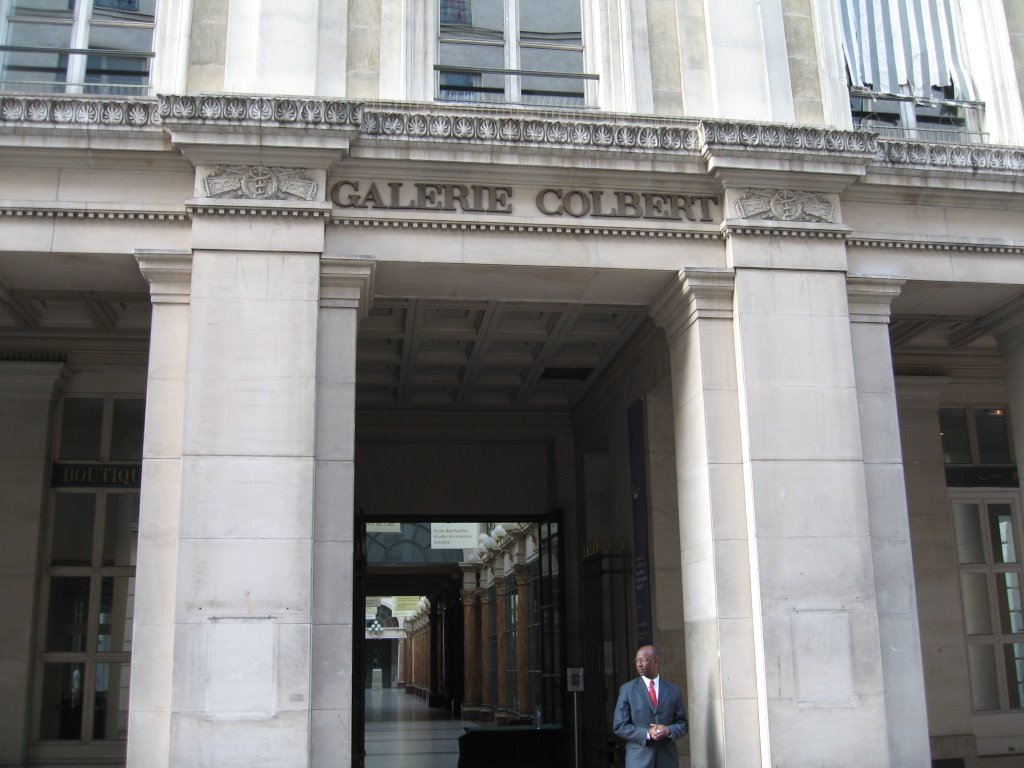
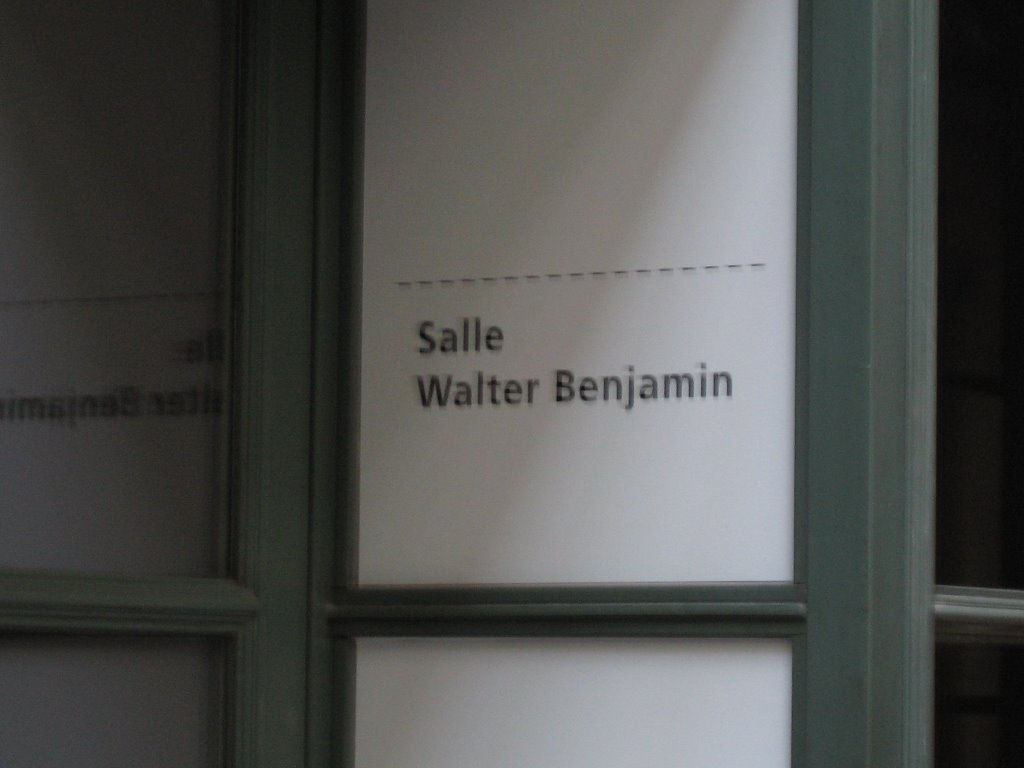
The Arcades Project Walter Benjamin
Phantasmagoria is the intentional correlate of immediate experience. M3a, 4
Experience is the outcome of work; immediate experience is the phantasmagoria of the idler. M1a,3
If you would like more pictures of passages: http://www.santm.com/gallery2/main.php?g2_itemId=7380&g2_page=2
and more: http://www.parisbestlodge.com/passages.html
and a little more:
http://paris.contexttravel.com/static/passages.php?sess=ct&PHPSESSID=15a34471cda15533ae8fda95efd
Friday, January 19, 2007
choiseul

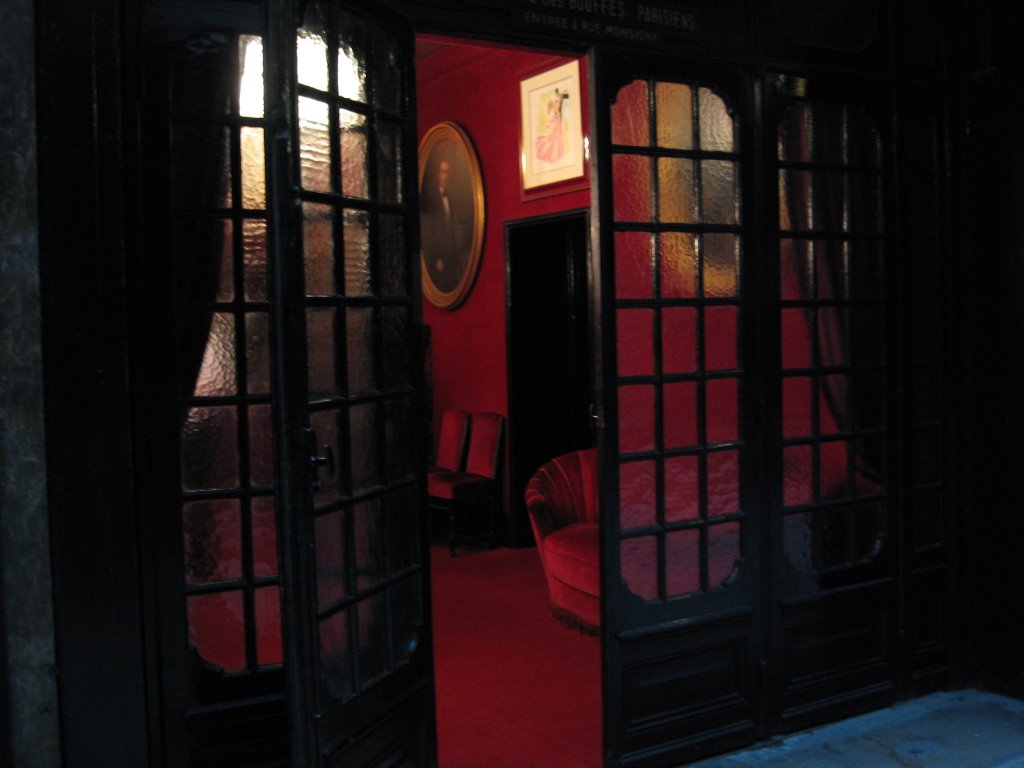
The Arcades Project Walter Benjamin
Boredom began to be experienced in epidemic proportions during the 1840's. Lamartine is said to be the first to have given expression to the malady. It plays a role in a little story about the famous comic Deburau. A distinguished Paris neurologist was consulted one day by a patient whom he had not seen before. The patient complained of the typical illness of the times: weariness of life, deep depressions, boredom. "There's nothing wrong with you," said the doctor after a thorough examination. "Just try to relax-find something to entertain you. Go see Deburau some evening and life will look different to you." "Ah, dear sir," answered the patient, "I am Dedrau." D3a, 4
Thursday, January 18, 2007
vivienne

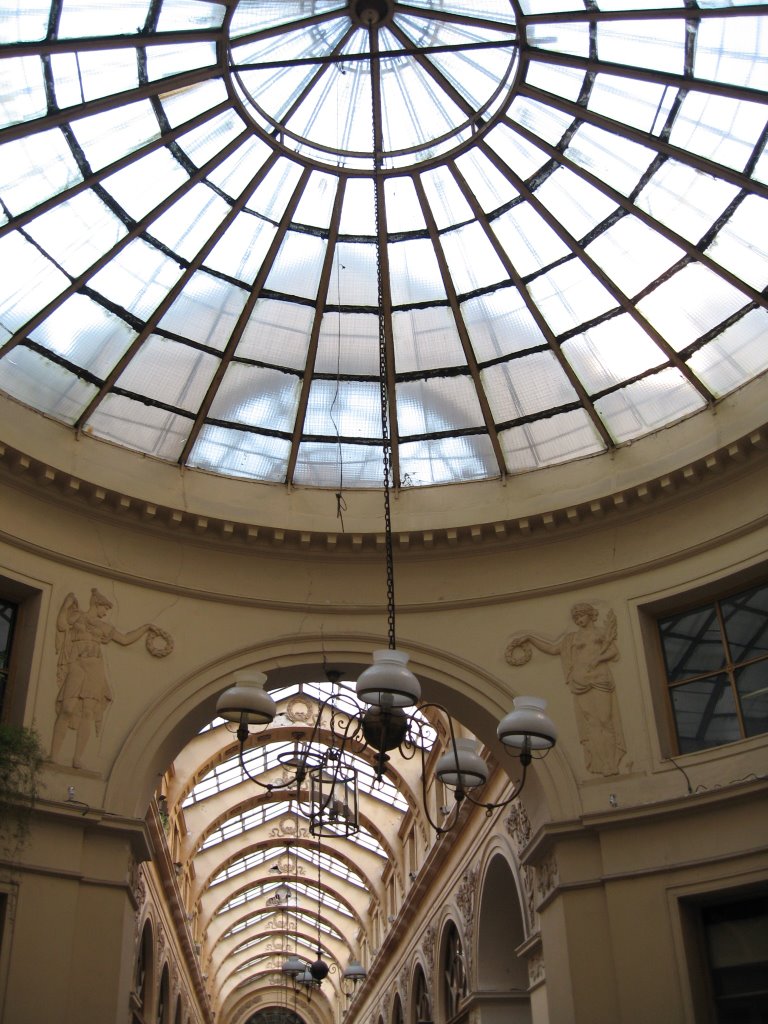
The Arcades Project Walter Benjamin
The father of Surrealism was Dada; its mother was an arcade. Dada, when the two first met, was already old. At the end of 1919, Aragon and Breton, out of antipathy to Montparnasse and Montmarte, transferred the site of their meeting with friends to a café in the Passage de l'Opéra. Construction of the Boulevard Haussman brought about the demise of the Passage de l'Opéra. Louis Aragon devoted 135 pages to this arcade; in the sum of three digits rides the number nine- the number of muses who bestowed their gifts on the newborn Surrealism. C1, 3
Wednesday, January 17, 2007
verdeau

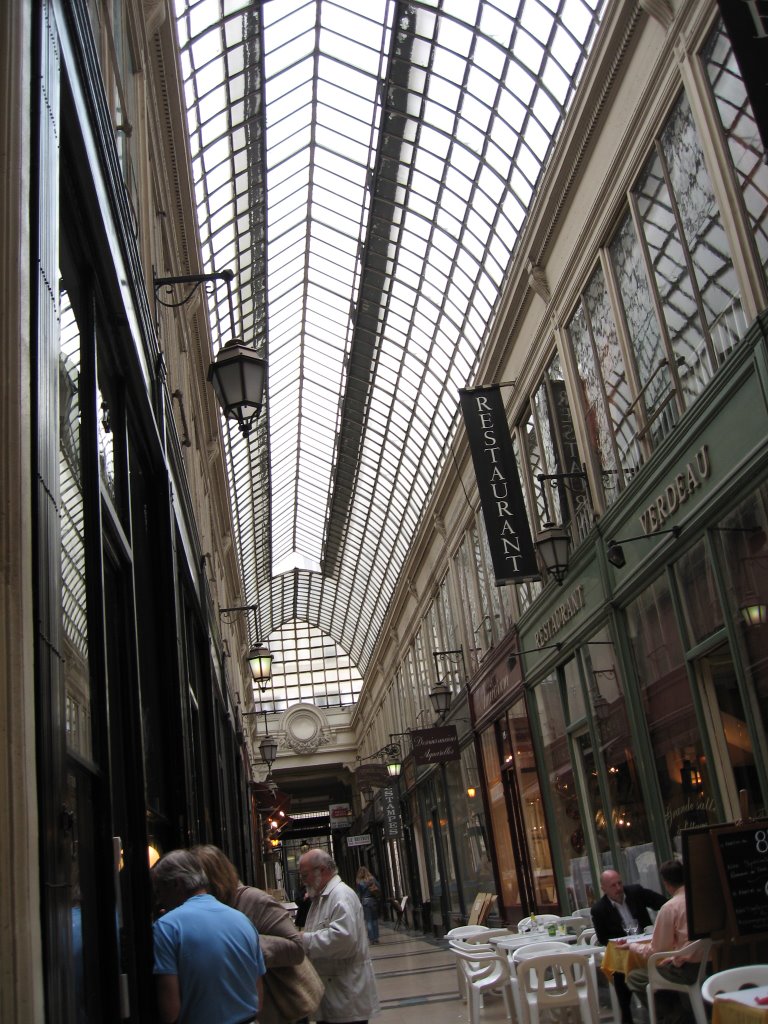
The Arcades Project Walter Benjamin
Arcades are houses or passages having no outside-like the dream. L1a, 1
The street conducts the flâneur into a vanished time. For him, every street is precipitous. It leads downward--if not to the mythical mothers, then into a past that can be all the more spellbinding because it is not his own, not private. Nevertheless, it always remains the time of a childhood. But why that of the life he has lived? In the asphalt over which he passes, his steps awaken a surprising resonance. The gaslight that streams down on the paving stones throws an equivocal light on this double ground. M1, 2
Tuesday, January 16, 2007
panoramas
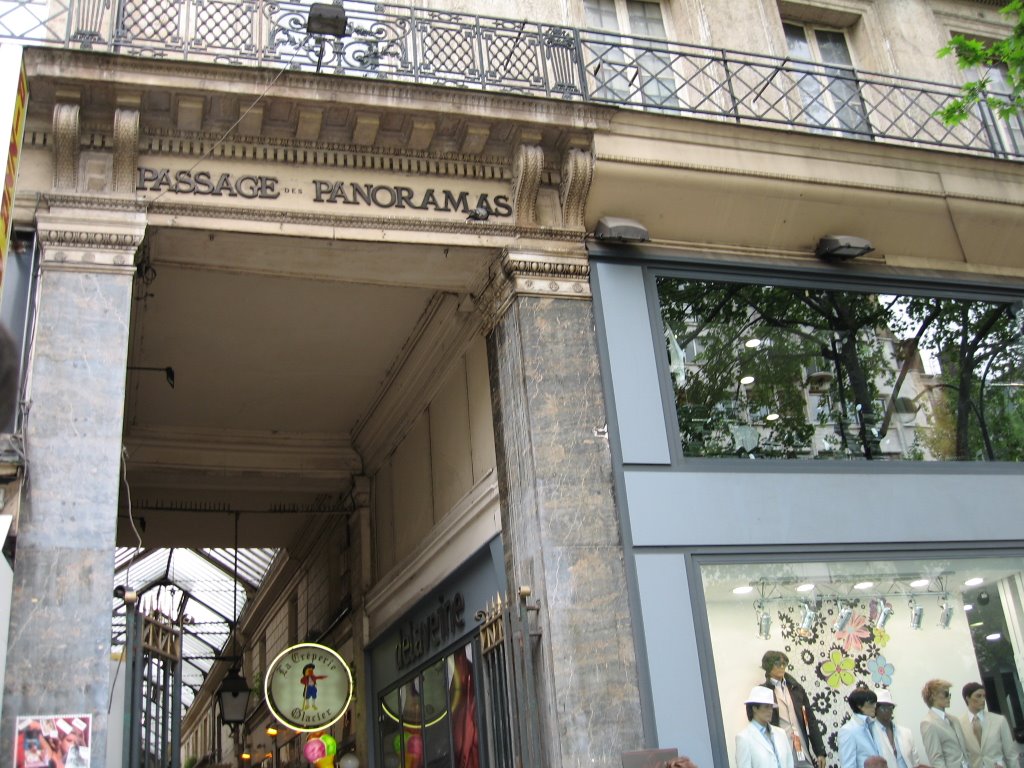

From The Arcades Project Walter Benjamin
The interest if the panorama is in seeing the true city- the city indoors. What stands within the windowless house is the true. Morever, the arcade, too, is a windowless house. The windows that look down on it are like loges from which one gazes into its interior, but one cannot see out these windows to anything outside. (what is true has no windows; nowhere does the true look out to the universe.) Q2a, 7
Friday, January 12, 2007
incarnadine



My internal question for today: Do assassins get issued 1099's?
I like W. He would be someone I would go to dinner with and get into a lot of debates about literature and writing. Or maybe I should just shut up and listen to him. I don't know if he is real or made up. I have imagined a few "friends" in my life, I have notebooks filled with the fragmented details of their lives. I wonder if I imagined a lover if I would also have to imagine our fights. Because it would be wholly unrealistic for me to be in a romantic relationship with someone without having fights, or least have debates; it would be completely uncharacterstic of me for this not to happen. Let's just say I have an incarnadine temper.
Wednesday, January 10, 2007
discordant
My internal question for today: Should I write a novel just for the hell of it? But what genre? Maybe I'll write a character-driven, faux-memoir in witty, discordant aphorisms with concurrent timelines as an extended metaphor for cladistic taximetrics. Or maybe I should write a "how to" book: "How to Avoid Marriage".
Why, do you ask, would I write a novel, since I do not care about publishing it nor do I care if anyone reads it? Well, I read this interview with author, Caitlin Kiernan, and I came across this line about her writing experience: "It was like having to spend every day sitting in front of a mirror, vivisecting my own brain." I thought to myself, "Hell, I do that everyday. If I wrote a novel, at least I would feel as though I had something to show for it." It would be parallel to getting a B.A. degreee for all the hours of sitting in a classroom letting someone dictate about what is worth knowing.
Monday, January 08, 2007
Ingurgitate

My mind restlessly ingurgitates library books faster than I can check them out.
My internal question for today: Why is it when one is described as prolific, it is considered a good thing?
Perhaps the secret of great writers is a love which flings opens the doors to let thoughts and feelings rush in.
http://www.powells.com/review/2007_01_08
Sunday, December 31, 2006
books read for 2006
Some people post their favourite music or movies for the year. I can only post the books I've read from 1/1/2006-12/31/2006, cover to cover. Next year, I hope to be a nicer person to have read ten more books than this year. ~Tschüs
* = a friend made me read it
# = a writer or about writer who has committed suicide (that I know)
1. Across the Acheron -Monique Wittig
2. The Math Gene -Keith Devlin
3. Isabelle: the Life of Isabelle Eberhardt -Annette Kobak
4. A Chance Meeting -Rachel Cohen
5. The Immense Journey -Loren Eiseley
6. The Dispossessed -Ursula LeGuin
7. The Death and Death of Great American Cities -Jane Jacobs
8. What am I Doing Here? -Bruce Chatwin
9. Ludwig Wittgenstein: A memoir -Norman Malcom
10. Madame Bovary -Gustave Flaubert (trans. Paul de Man)
11.Three Women (Alma Mahler-Werfel, Gertrude Stein, Lous Andres-Salome) -Walter Sorell
12. The Road to Santiago -Kathryn Harrison
13. Fin de Siècle Vienna -Carl Schorske
14. Gathering Moss: A Natrual & Cultural History of Mosses -Robin Wall Kimmerer
15. # Moscow Diary -Walter Benjamin
16. # The Disinherited: The Life of Gérard de Nerval -Benn Sowerby
17. The Urban Ideal: conversations with Paolo Soleri
18. City Life: Urban Expectation in a New World -Witold Rybczynski
19. *Passage -Connie Willis
20. Color: A Natural History of the Palette -Victoria Finlay
21. The Flâneur -Edmund White
22. # The World of Yesterday -Stefan Zweig
23. Sade my Neighbor -Pierre Klossowski
24. California Forests and Woodlands: A Natural History -Verra R. Johnston
25. Oakland: A History -G.A. Cummings & E.S. Pladwell
26. Waiting for Godot -Samuel Beckett
27. # Insatiability -Stanislaw I. Witkiewicz
28. My Lives -Edmund White
29. *Bellwether -Connie Willis
30. Stiff: The Curious Lives of Human Cadavers -Mary Roach
31. Nausea -Jean-Paul Sartre
32. Tête –à Tête -Hazel Rowley
33. # Shadows of the Sun: The Diaries of Harry Crosby ed. Edward Germain
34. Exquisite Corpse: Surrealism and the Black Dahlia Murder -Mark Nelson & Sarah Bayliss
35. # Freud's Vienna and other Essays -Bruno Bettelheim
36. # The Painted Bird -Jerzy Kosinski
37. Blue Angel -Francine Prose
38. Faust & Yakov Pasynkov -Ivan Turgenev
39. The Portrait of Mr. W.H. -Oscar Wilde
40. Justine -Lawrence Durrell
41. The Great Gatsby -F. Scott Fitzgerald
42. The Modern Mind: An Intellectual History of the 20th Century -Peter Watson
43. Blue of Noon -Georges Bataille
44. Shakespeare and Company -Sylvia Beach
45. #A Room of One's Own -Virginia Woolf
46. The Great Pianists -Harold Schonberg
47. Curious Naturalists -Niko Tinbergen
* = a friend made me read it
# = a writer or about writer who has committed suicide (that I know)
1. Across the Acheron -Monique Wittig
2. The Math Gene -Keith Devlin
3. Isabelle: the Life of Isabelle Eberhardt -Annette Kobak
4. A Chance Meeting -Rachel Cohen
5. The Immense Journey -Loren Eiseley
6. The Dispossessed -Ursula LeGuin
7. The Death and Death of Great American Cities -Jane Jacobs
8. What am I Doing Here? -Bruce Chatwin
9. Ludwig Wittgenstein: A memoir -Norman Malcom
10. Madame Bovary -Gustave Flaubert (trans. Paul de Man)
11.Three Women (Alma Mahler-Werfel, Gertrude Stein, Lous Andres-Salome) -Walter Sorell
12. The Road to Santiago -Kathryn Harrison
13. Fin de Siècle Vienna -Carl Schorske
14. Gathering Moss: A Natrual & Cultural History of Mosses -Robin Wall Kimmerer
15. # Moscow Diary -Walter Benjamin
16. # The Disinherited: The Life of Gérard de Nerval -Benn Sowerby
17. The Urban Ideal: conversations with Paolo Soleri
18. City Life: Urban Expectation in a New World -Witold Rybczynski
19. *Passage -Connie Willis
20. Color: A Natural History of the Palette -Victoria Finlay
21. The Flâneur -Edmund White
22. # The World of Yesterday -Stefan Zweig
23. Sade my Neighbor -Pierre Klossowski
24. California Forests and Woodlands: A Natural History -Verra R. Johnston
25. Oakland: A History -G.A. Cummings & E.S. Pladwell
26. Waiting for Godot -Samuel Beckett
27. # Insatiability -Stanislaw I. Witkiewicz
28. My Lives -Edmund White
29. *Bellwether -Connie Willis
30. Stiff: The Curious Lives of Human Cadavers -Mary Roach
31. Nausea -Jean-Paul Sartre
32. Tête –à Tête -Hazel Rowley
33. # Shadows of the Sun: The Diaries of Harry Crosby ed. Edward Germain
34. Exquisite Corpse: Surrealism and the Black Dahlia Murder -Mark Nelson & Sarah Bayliss
35. # Freud's Vienna and other Essays -Bruno Bettelheim
36. # The Painted Bird -Jerzy Kosinski
37. Blue Angel -Francine Prose
38. Faust & Yakov Pasynkov -Ivan Turgenev
39. The Portrait of Mr. W.H. -Oscar Wilde
40. Justine -Lawrence Durrell
41. The Great Gatsby -F. Scott Fitzgerald
42. The Modern Mind: An Intellectual History of the 20th Century -Peter Watson
43. Blue of Noon -Georges Bataille
44. Shakespeare and Company -Sylvia Beach
45. #A Room of One's Own -Virginia Woolf
46. The Great Pianists -Harold Schonberg
47. Curious Naturalists -Niko Tinbergen
Tuesday, December 26, 2006
ataraxy
Quick notes on feelings:
The past has past. I can't complain, nor would I want to. I drank three pots of pu-erh on Christmas Eve. and read the biography of Weldon Kees. I felt calm; this is the way I hope always get to spend my free time: books and tea (or an amaretto sour). I sincerely hope that all those who I have loved are loved now. I wish them all moments of joy.
A quick link of an article on Weldon Kees-
http://www.newyorker.com/critics/atlarge/articles/050704crat_atlarge?050704crat_atlarge
kisses~
The past has past. I can't complain, nor would I want to. I drank three pots of pu-erh on Christmas Eve. and read the biography of Weldon Kees. I felt calm; this is the way I hope always get to spend my free time: books and tea (or an amaretto sour). I sincerely hope that all those who I have loved are loved now. I wish them all moments of joy.
A quick link of an article on Weldon Kees-
http://www.newyorker.com/critics/atlarge/articles/050704crat_atlarge?050704crat_atlarge
kisses~

Subscribe to:
Posts (Atom)
