Friday, August 17, 2007

debouch


Stolen pictures- left side- from this website: http://capacioglu.stumbleupon.com/

the right, Hiroshi Sugimoto, from this site- http://www.kultureflash.net/archive/68/.

Sugimoto is currently being exhibited at the De Young Museum in San Francisco, I saw the exhibit, it covers the variety of his photos; from the minimalism (as shown in this photo) to his faux-figuratives.


Today's obsessions:


What would ancient perfume smell like? "Extracts of anise, pine, coriander, bergamot, almond, and parsley "


Joseph Conrad:


"To survey with wonder the changes of one's own self is a fascinating pursuit for idle hours. The field is so wide, the surprises so varied,the subject so full of unprofitable but curious hints as to the work of unseen forces, that one does not weary easily of it. I am not speaking here of megalomaniacs who rest uneasy under the crown of their unbounded conceit--who really never rest in this world, and when out of it goon fretting and fuming on the straitened circumstances of their last habitation, where all men must lie in obscure equality. Neither am I thinking of those ambitious minds who, always looking forward to some aim of aggrandizement, can spare no time for a detached, impersonal glance upon them selves"


The Estonian language:


"The majority of European languages belong to the Indo-European language group (e.g. Spanish, Polish, Lithuanian, Norwegian, Albanian, Romany, Greek or Welsh). Of the ancient European languages, once so widespread throughout the continent, Basque in the Pyrenees, the Finno-Ugric languages in the North and Central Europe, and Caucasian languages (e.g. Georgian) in the southeastern corner of Europe have managed to survive.

The Estonian language belongs to the Finnic branch of Finno-Ugric group of languages. It is not therefore related to the neighbouring Indo-European languages such as Russian, Latvian and Swedish. Finnish, Hungarian and Estonian are the best known of the Finno-Ugric languages; rather less known are the following smaller languages of the same language group: South Estonian, Votic, Livonian, Ingrian, Veps, Karelian, Sami, Erzya, Moksha, Mari, Udmurt and Komi, spoken from Scandinavia to Siberia. The relations between languages can often be seen from the similarities in numeric systems:


Estonian differs from its closest large related language, Finnish, at least as much as English differs from Frisian. The difference between Estonian and Hungarian is about as significant as between German and Persian.

Along with Icelandic, Estonian is at present one of the smallest languages in the world that fulfils all the functions necessary for an independent state to 'perform' linguistically. Teaching, at both primary school and university level, is in Estonian; it is also the language of modern science (molecular biology, astronomy, computer science, semiotics, etc.). Estonian is used in the army, in the theatre, aviation, journalism - in all walks of life. Estonian is the only official language in Estonia in local government and state institutions.


Estonian is spoken by approximately 1 100 000 people throughout the world. About 950 000 of them live in Estonia, and more than 150 000 are scattered over Sweden, Canada, USA, Russia, Australia, Finland, Germany and other countries. The first attempts to describe the Estonian language scientifically were undertaken in the early 17th century. In 1803, a lectureship of the Estonian language was established at what was then the German-language University of Tartu, founded in 1632. With the spread of the ideas of Enlightenment, the interest of the Baltic German Estophiles in the local language and culture increased. During the 19th century, the first educated Estonians began publishing scholarly research of their mother tongue. The first doctor of the Finno-Ugric languages of Estonian origin was Mihkel Veske who did research into the history of the Estonian language in the 1870s; the Estonian Writers' Union, established in 1871, undertook the task of standardising the common language. "


Tuesday, August 14, 2007

Hunger

I read it with relish, I started on Sunday and finished this morning (Tues.) on BART, on my way to work. I felt uncomfortable reading it while having breakfast. I felt deranged while reading it at a full cafe in Berkeley on a Monday afternoon. I walked by two or more cafes, filled with Berkeley students studying diligently for the summer semester. When I finished the book, I wondered if all my readings of such depraved characters were going to drive me to lunacy. I guess we will find out, since I do not see myself eliminating such literature from my reading list any time soon.

Here's one excerpt I found when I randomly opened the book, it is tame, comparatively.

"Not a sound came to disturb me-the soft dark had hidden the whole world from me, and buried me in a wonderful peace- only the desolate voice of stillness sounded monotonously in my ear. And the dark monsters out there wanted to pull me to themselves as soon as night came, and they wanted to take me far far over seas and through strange lands where no human being lives. " -Hunger Knut Hamsun

Here's a New Yorker article on Hamsun from December 2005:

"...Isaac Bashevis Singer argued that "the whole modern school of fiction in the twentieth century stems from Hamsun, just as Russian literature in the nineteenth century ‘came out of Gogol’s greatcoat.’ ” In Scandinavia, though, Hamsun meant trouble. During those months in Copenhagen, I occasionally walked into one of the antiquarian bookstores that could be found all over the city’s Latin Quarter. Several times when I asked about Hamsun’s works, the man behind the counter (it was always a man) would shake his head and declare, “He was a traitor!” I’d try to remember the shop so as not to embarrass myself again."

Wednesday, August 08, 2007

ghastly, indeed


More clues about Europe before the World Wars, about the maps above: 1. Europe roughly after the Congress of Vienna 2. The corresponding language groups. From this website.

Congress of Vienna, on October 2, 1814


"What struck them first was the light. Sixteen thousand candles and thirty-two chandeliers lit up two ballrooms in the imperial palace, where the glass windowpanes had been replaced with mirrors, redoubling the splendor.

Geographically, the problem at Vienna was roughly the same as the one facing the Allies at Potsdam in 1945. Russia, which bore the brunt of the war against Napoleon, had marched its armies across Europe and was now effectively in control of Poland and much of Prussia. Alexander, who had a messianic dream of restoring Poland to the map as a kingdom under his control, refused to give back the parts of Poland that had formerly belonged to Prussia. As a result, Prussia sought compensation to the west, demanding to annex the independent kingdom of Saxony. Austria, meanwhile, under the wily conservative Metternich, hoped to maintain a balance of power, to rein in Alexander's ambitions, and to keep Prussia from dominating the smaller German states. It was a thoroughly unedifying spectacle, in which the great powers swapped cities and provinces like horse-traders, while the claims of small nations were ruthlessly ignored."


"Indeed, the Walser tone, hovering between beatific quietism and a burlesque of conventionality, is detectable in the immortal reply he gave a man who visited him at an asylum and asked about his writing: 'I am not here to write, but to be mad.'"


"Nancy Cunard paid a high price for her nonconformity. She was disinherited, arrested, beaten, institutionalized and eventually declared insane. Her legacy includes her refusal to regret, or attempt to explain, any of it.

Cunard was like "some invention, ghastly or not, of her own.... She didn't fit anywhere." That inconsistency or "passionate inconstancy," as William Carlos Williams called it, consisted of, as one male friend described it, "baffling contradictions"--she was passionate but unromantic, loyal but unforgiving, unconventional but fastidious, emotional but unsentimental, hedonistic but anorexic. Huxley summed her up as "one of those women who have the temperament of a man." Ghastly indeed."


"Characters die from humiliation in Max Ophuls or, to put it cruelly, they die from frustration. {…}Absorbed totally in passion, nothing else exists, as Stendhal says again, and frustrated passion crystallizes like crazy, becomes obsession, and dominates us totally. {…}Passion makes us prisoners first, then criminals."

Then, in the interest of getting away......

"The problems started when I put down my fork. Unable to find it among the plates, wine glasses, and baskets of bread, I resorted to shovelling steak into my mouth by hand - but I didn't worry about offending the well-mannered Parisians seated nearby. They couldn't see a thing."

Monday, August 06, 2007

Books read in July

Books I read in July and why I read them.


1. Bâtarde- Violette Leduc

I read this essay in Context, a newsletter which I would pick up for free in Diesel Bookstore. I was seduced into the sensual and emotionally overwrought material this novel/memoir promised to cover. Since the book was out of print, I did not expect to easily come across it, so I kept it in the back of my mind as a book to keep an eye out for. On one of my rare Green Apple visits, I wandered around, and there was Bâtarde, tottering on top of a haphazard, yet standing, pile of books. Thus, there, I purchased it. It took me another few years to get around to reading it. The book's heft and personal subject kept me at an arm's length.

It was not as good as I wanted it to be. But I'm beginning to think this is the theme of my life, perhaps it can be my epitaph: "It was never as good as she wanted it to be." Sadly, I won't have a grave, or a gravestone, maybe it can be carved into a plaque above my favourite haunt.

There are beautifully written moments in this work: including a fantastic passage describing an endive salad and her enticing account of her black-marketing during WWII.
Most of the time, however, I felt mucked down by her barrage of emotional tumult.

I was having lunch at a Chinese restaurant one day, reading the book intently, trying to finish it. A man who was dining next to me asked me how the book was. My answer:" It's like being in a relationship you want out of, but you are committed to the end." That is how I felt about reading La Bâtarde, after 187 pages I felt committed, but I was quite relieved when it ended.

2. A Stranger in a Strange Land - Robert Heinlein

This book has somehow stayed with me despite the great book purge of 2005, when I had to move, and I rid myself of at least a few huge boxes of books. I must have picked it up for free from some giveaway pile because it is a cheap, grungy little paperback. I'm not even sure what could have compelled me to pick it up in the first place. I really didn't know anything about this book or the author. I decided to read it after seeing it in a book called 1001 Books You Should Read Before You Die, which, by the way, I don't agree with all the choices. Since I had Stranger around, I thought I would at least read it so I could get rid of it.

It is not too bad for a dated science-fiction utopian paperback. The dialogue conveys the characters well, but the free-love, cult storyline chippers into martyr-fantasy cheesiness. There are some novels where the writer's desired take on reality gets worn on the page; this novel is such an example.


3. Three Years- Anton Chekhov

I was delusional enough to think I might start reading Don Quixote this summer. So I ambled to my local library to check it out. While I was in the C's, I saw this slim novelette by Chekhov, since I had read another of his small novels (Story of Nobody) I knew I would enjoy it, plus I could read it easily in case the Cervantes fell through (which it did). But I will read Don Quixote before I die, even if I die while reading it. It is my folly, this desire to read the greatest novels of all time. Plus I feel rather embarrassed that I have not read it yet, I can't even believe I'm admitting it here.

Chekhov writes about disappointment and mundane life, but he does it without sentiment. He says a lot in a little amount of pages, it inspires me.


4. The Heart is a Lonely Hunter - Carson McCullers

Again, I was in another public library, this time in Berkeley. I decided that I wanted to read another book by Moravia, on passing through, I came across McCullers' book, and on an impulse I decided to check it out as well. I think I heard of this McCullers' book because it is #17 on the MLA, and as I mentioned before, I'm a sucker for those listed books. For the record, it is not in the 1001 Books, so I think it has lost some of its appeal through time, after all it was published in 1941 when McCullers was only 23.

It does have some juvenile character developments; it feels as though Mc Cullers wanted to bring all the misfits she could imagine together in a sleepy Southern town. The misfits have so much to say that it is bursting right out of them but they are unwilling to listen.

Overall, July was not as productive as I would have liked, hopefully August will be a better read.

Friday, August 03, 2007

lacuna

Ok- That's it, everyone can packup and leave now.


Interactions like that make me want to move to Belgium and never talk to anyone and never know anyone ever again. And there are some who want to make it seem a lot better than it ever could be:

“I struggled to come to terms with this new knowledge,” Goodall later wrote. She would wake in the night, haunted by the memory of witnessing a female chimpanzee gorging on the flesh of an infant, “her mouth smeared with blood like some grotesque vampire from the legends of childhood.”

Wednesday, August 01, 2007

nocturnes


I encountered a strange and sad story yesterday, which fits the overall uncanniness of this week, another and another.

Curious blog exchange with the deceased.


Things I've been thinking about:

1. The intellectual history of books.

2. Western history, especially how the events that caused WWI which led us to our current state. I started reading Jacques Barzun's Dawn to Decadence to hopefully enlighten me. I have to say, his writing style is quite peculiar and it has taken time for me to adjust to it.

3. The taxonomy of friendships and that very fluid nature of intimacy

4. The subjective appreciation and naming conventions of colors-example: When is mauve a mauve?

5. Nocturnes- an excerpt from Grove Music:

"A piece suggesting night, usually quiet and meditative in character, but not invariably so. The Italian term Notturno occurs frequently as a title in 18th-century music, but the French form of the word was not used until John Field applied it to some lyrical piano pieces written between about 1812 and 1836 Field’s nocturnes are historically important as antecedents of Chopin’s. The writing is clearly idiomatic, exploiting the sounds available on the newer pianos; the sustaining pedal, in particular, enabled Field to expand the range of the harmonic accompanying patterns beyond those of the Alberti bass, which of necessity lay under the hand. The melodies of his nocturnes transferred to the keyboard the cantilena of Italian opera, to which he had been exposed in Russia in the early 1800s (see ex.1). According to Liszt, who wrote a preface to the first collected edition of Field’s nocturnes (Leipzig, 1859), they ‘opened the way for all the productions which have since appeared under the various titles of Songs without Words, Impromptus, Ballades, etc., and to him we may trace the origin of pieces designed to portray subjective and profound emotion’.
Although the emotional range of most of Field’s nocturnes is not wide, and the phrase structure sometimes tediously predictable, the restrained elegance of his musical language and imaginative keyboard figuration made a great impression on subsequent Romantic composers, especially Chopin, who admired both Field’s playing and his compositions. Nocturnes were composed by most pianist-composers of the time, including Liszt (whose famous Liebesträume song transcriptions were subtitled ‘nocturnes’), Schumann (Nachtstücke op.23), J.B. Cramer, Czerny, Kalkbrenner, Thalberg, Henri Bertini and Theodor Döhler among them. Chopin’s 21 nocturnes, however, hold a pre-eminent place in the history of the genre. The celebrated Nocturne in E♭ op.9 no.2 is perhaps the most similar to Field’s nocturnes, showing the influence of two of his nocturnes in the same key in both melody and accompaniment patterns. It was, however, Field’s Nocturne no.4 in A major, with its agitated, harmonically more complex, central section, that proved more inspirational for Chopin’s expansion of the form in his op.9 no.3 and later pieces.
Chopin’s nocturnes (especially op.48 no.1) display an intensity well beyond the range of Field and a high degree of melodic invention (ex.2). His remarkable harmonic sophistication, too, is often couched in keyboard textures of a contrapuntal complexity that never seems redundant or forced. Moreover, several diverge from Field’s basic ABA formal outline. The otherwise suave op.32 no.1 in B major ends unexpectedly in B minor with an abrupt, recitative-like coda that appears in emotional terms to contradict all that has gone before, while op.15 no.3 in G minor is in a highly unusual AB form with no recapitulation of the initial material.
Although the apogee of the pianistic nocturne was reached with Chopin, it continued to be a popular genre. French composers were particularly attracted to the form: Fauré wrote 13 nocturnes, and Satie, d’Indy and Poulenc contributed to the repertory. Liszt’s late works include the nocturne En rêve (1885) and celebrated nocturnes were also composed by Glinka, Balakirev, Tchaikovsky (op.10 no.1 in F major and op.19 no.4 in C♯ minor), Rimsky-Korsakov (Nocturne in D minor), Skryabin and Grieg (Notturno in C major op.54 no.4). Nocturnes were also written for orchestra; a well-known example is in Mendelssohn’s incidental music for A Midsummer Night’s Dream, where the tone-colour of the horn is used, as in the 18th-century notturno, to evoke the image of night. Bizet wrote an unpublished nocturne for orchestra, and Debussy’s Trois nocturnes (Nuages, Fêtes and Sirènes, the last with a female wordless chorus) are among the finest achievements of French impressionist music; Fêtes, a vigorously rhythmic and extrovert piece, considerably expands the usual associations of the term ‘nocturne’ to portray nocturnal festivities."

Friday, July 27, 2007

Three Years

"Yes, everything under the sun comes to an end," he said quietly, screwing up his dark eyes. "You'll fall in love and you'll suffer, fall out of love and you'll be deceived, because there isn't a woman that won't deceive you, you'll suffer, fall into despair and you yourself will deceive. But the time will come, when all this will be just a memory, and you'll reason coldly, and consider it trivial…"

-Anton Chekhov Three Years

Wednesday, July 25, 2007

idle matter

I'm bored, I've been bored for the last month, I do not know why. I am engaged in daily activities which make me feel satisfied, but I feel that I am somehow infected with a taedium vitae. I think I might need take a class, or to change jobs, or move to another country. Today, I thought of some "titles", in attempts to humor myself:

1. Exercises in Tragedy
2. How to Complete the Unspeakable
3. Experiencing Unnecessary Boredom

Then I searched "idle chatter" on google and found this strange thing:


"Why does Tim Hawkinson like to play with himself so much? Why does he goof around with his own body, measuring it and categorizing it? Why does he make such beautiful little things with the detritus that falls from it? Why does he make such charming and amusing things at all?"

and from the New Yorker:

"Weird week. Weird, weird week, passing from alert orange to heavenly white and back to the usual muddle of slush. People keep trying to "gauge public opinion" at this moment of crisis. Fortunately, though, in the past year in New York we've had on hand a machine that can tell you what the world is thinking—that actually listens to the world, reads its mind, and tells you exactly what's up in there. The machine, a Jimmy Neutron assemblage of display monitors and loudspeakers and copper wire, is the brainchild of a Bell Labs statistician named Mark Hansen and a sound designer and artist named Ben Rubin, and for most of the past year you could find it in a loft on the Bowery, where you could drop in on it if you knew it was there. For the past couple of months, though, it has been on loan to the Whitney Museum of American Art, and in a rough week it was a pleasure to sit in the dark and listen."

And just for fun, I searched "colorfields" in the New Yorker and found this:

"At a boozy dinner party that I attended in a New York walkup nearly thirty years ago, a woman announced that she was getting married. Joan Mitchell, who was there, exploded. How could anyone even think of doing something so bourgeois? The buzzer sounded. It was Mitchell's longtime lover, the French-Canadian painter Jean-Paul Riopelle. He wanted to speak to her, but he wouldn't come upstairs. From the landing, she told him in scorching terms to leave her alone. Back at the table, she resumed denouncing the insidiousness of marriage as a trap for free souls. The buzzer again. Another cascade of profanity down the stairwell. I was awed. Here was craziness of a scary and rare order. Those who knew Joan Mitchell pass these kinds of stories around like sacred-monster trading cards. But Mitchell's personality was one thing, and her art is entirely another."

Another dull day saved by New Yorker randomness..........

Sunday, July 22, 2007

Picture July

Big City Orchestra
View from Angel Island towards Tiburon, July 4th, 2007
Tree bark, Angel Island, July 4th, 2007
Chocolate Salon, San Francisco

Wednesday, July 18, 2007

Europe

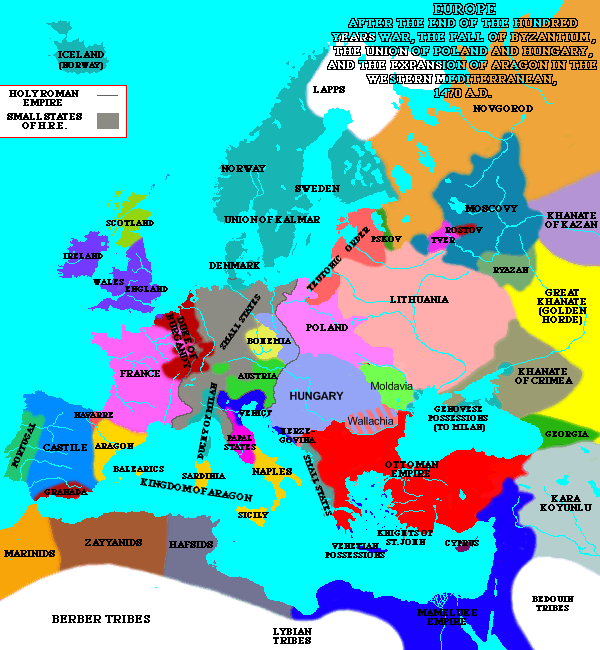
I found it interesting to see how much Europe has changed in the years. See this map from 1470? See how huge Lithuania is and how present day Spain is actually four "kingdoms": Castille, Granda, Navarre and Aragon, yet there is no mention of the Basque country.

map from Wiki

http://upload.wikimedia.org/wikipedia/commons/4/4f/Europe_in_1470.png


Now here's a map of Europe right before WWI. No Lithuania in sight and Spain has been unified, and Austria-Hungary dominates Europe, but we know how that changes. Time to hit the history books to see how this all comes about.


Friday, July 13, 2007

Strange Bedfellows

F. Scott Fitzgerald influenced Hunter S. Thompson?-Believe it! (from The New Yorker 3/7/2005)

He {Thompson} also seems, by virtue of the “outlaw” accoutrements, to belong to the tradition in American writing that includes William Burroughs, Jack Kerouac, and Henry Miller. But his true model and hero was F. Scott Fitzgerald. He used to type out pages from “The Great Gatsby,” just to get the feeling, he said, of what it was like to write that way, and Fitzgerald’s novel was continually on his mind while he was working on “Fear and Loathing in Las Vegas,” which was published, after a prolonged and agonizing compositional nightmare, in 1972.

Speaking of Thompson- a little known LSD Maverick

How I spend my week:

I spent this week (except for work and roommates) alone. I find that I enjoy this solitude tremendously.I think I am going to replace my friends with habits. At least with habits I feel more productive; habits include: running, reading, learning, (many things but mostly history, literature, and possibly a few foreign languages), writing, and practicing piano. I also find that I enjoy watching films at PFA, so last night I viewed a double feature. This, I have never done before, I never thought I had the endurance to watch two films in a row, but I surprised myself. It was part of the Barbara Stanwyck program, I saw two films directed by Douglas Sirk, starring, of course, Stanwyck. It turns out that Monday, July 16 is Stanwyck's 100th birthday. "All in all, as Sugarpuss says, 'Pretty good getting, for a gal that came up the hard way.'” The New Yorker wrote a good article a few months ago on Stanwyck which the two films I saw were mentioned:

"Even Douglas Sirk, the master colorist, stuck to black-and-white when he hired Stanwyck for two of her final melodramas, “All I Desire” and “There’s Always Tomorrow” (1956). Sirk found in her “an amazing tragic stillness,” while praising her discretion: “She gets every point, every nuance without hitting on anything too heavily.” The closeup of her tears, in the first of those films, as her character walks up the path to her family home, to the sound of violins, should be the merest hokum, yet it stirs us like the last dying echo from the age of Garbo. And remember: Stanwyck herself never had a family home."

Now looking forward to a weekend of habits.

Wednesday, July 11, 2007

Lost Coast


These are pictures taken of the Black Sand beach on the Lost Coast in northern California. They were taken in June 2003 on my only visit there. I've read about it for a few years before I actually was able to visit the area, sadly I was there only for a few hours when we were coming down from Arcata back to the Bay Area. The Lost Coast is 80 miles of shoreline starting just north of Rockport where Highway 1 turns inland to connect with Highway 101. There is only one road that leads back into the coast; it is the road into Shelter Cove.

There are days which I would love to disappear into a vast and dispassionate landscape. I would get swept up in the view of the sea. I would forget names and spend my days wandering. The only sounds I would hear would be the ocean and its inhabitants. Someday I would like to go back.

Thursday, July 05, 2007

word of the day

Dear Reader, (maybe I should start all my posts this way)

The word of the day on July 4, 2007 was phantasmagoria, curious, is it not? And here is the example sentence:

"The new writings more and more take the form of apocalypses -- that is, of supernatural visions which reveal past, present and future under the guise of a phantasmagoria of symbolic persons and animals, divine and diabolical beings, celestial and infernal phenomena."-- Edmund Wilson, The Dead Sea Scrolls: 1947-1969


In other New Yorker news, last night I read this magnificent set of adjectives describing Klaus Kinski- "...gifted but satanically mercurial star..." in a April 2006 Profile on Werner Herzog. I'm sure I could be described as satanically mercurial during specific times in my life, but not gifted, sadly.

And more about Herzog:

“I am always being stopped at airports by drug-interdiction officials,” he said, with satisfaction. “There is something about my face that is sinister.” The aura is heightened by his sonorous voice, which, in his heavily accented English, suggests a Teutonic Vincent Price. Herzog likes to say that he is “clinically sane and completely professional,” but he is keenly aware that his reputation is otherwise—“One of the most persistent rumors plaguing me is that I’m a crazy director doing crazy things”—and he is fascinated by the myriad ways that people form this impression.

Fun things to do when you are bored: type in a random word or phrase into the New Yorker search box and see what pops up. For example, if you type in "murder", you may get this article.

"The murderer can’t find a parking space. A hard morning spent murdering people, and now this. He has errands to run, the murderer. What a week he’s had, and it’s only Thursday. Just look at his schedule:

Monday murder somebody
Tuesday murder somebody
Wednesday sit around
Thursday murder somebody; do errands"

This may be one of a few things that make the United States an interesting country, from a June 25, 2007 article in the New Yorker.

"Orchestras at the level of the Nashville used to be described as “regional” or “second tier,” but increasingly they display the virtuoso panache of front-rank ensembles. The conservatories are producing wave after wave of almost excessively skilled players, and, like Ph.D.s in the humanities, hundreds of them fan out across the continent each year in search of jobs. They may stay with a regional orchestra for only a season or two before moving on to a higher salary, but they raise the level of playing as they go. A well-travelled soloist recently told me that players are often better than the conductors who lead them."


Monday, July 02, 2007

La Bâtarde

"You can guess, reader, you have already guessed, it is the end of a love affair, it is the end of tyranny. Love. Love has no end. If it had, it would not be love. We go on loving those we have loved in other forms, or else we begin to cherish in other forms those we should have loved in the past. Nothing changes, everything is transformed."

-Violette Leduc


Maybe, at the end of the day, all I need is a good dosage of this: New Drug Deletes Bad Memories

Thursday, June 28, 2007

the rest of June books

Books read for June for fiction-only summer, 2007 with short, very short discussions.

1. Started: 6/8/2007 Finished 6/13/2007
Despair, by Vladimir Nabokov

Mixed into a story of finding one's double, belies some Nabokovian treatises on art and duplicity. The narrator attempts the pefect murder under the guise of suicide. He is perceptually flawed, since he does not have the objectivity to see if the double he has selected can really pass for himself. The authorities reveal his crime as defective. Nabokov somehow entertwins some ideas on literary criticism parallelling with the presses persecution treatment of the murder within the story.

Should you read it? Yes, if you like Nabokov and/or if you like stories of psychologically questionable characters.


2. Started 6/13/2007 Finished 6/16/2007
Contempt, by Alberto Moravia

Obssessive story of a man's loss of his wife's love. The narrator, a writer, sells himself out by writing screenplays instead of the works he was inspired to do. He blames his wife's need for a house and other material necessities which drove him to write for money instead of writing for art. We never know the wife's perspective, all we learn about the relationship is completely based on his interpretation. As the story unfolds, the reader learns that the narrator is not to be trusted, but in fact he misunderstands and misinterprets many scenes.The language obscures the narrator's growing mania, since the story is written in an analytical and detached manner.

Should you read it? Yes, if you like to peer into the dark mind of the psychologically spurious, (see also, above book) and if you like to read about a relationship slowly going to hell.


3. Started 6/17/2007 Finished 6/18/2007
Jane Eyre, by Charlotte Brontë

Gripping Victorian love story of a unloved orphan (Jane Eyre) and her eventual, but tantalizing falling in love with the Byronic (i.e. tragic & brooding) "hero", Mr Rochester. Along the way, she acquires a good education, develops ladylike qualities, becomes a governess and a teacher, and inherits some money from a long lost uncle.There's a mad woman in the attic which disrupts some marriage plans, and second marriage proposal, just to keep things lively.

Should you read it? Yes, if you like gripping Victorian romances written by previously underappreciated women writers.


4. Started 6/18/2007 finished 6/21/2007
Heart of Darkness, by Joseph Conrad

Nefarious collision tale between civilization and barbarism and the madness that imperialism and colonialism produces. Marlow sneaks up the Congo to track down the elusive and diabolical Kurtz. Classic novel focusing on the construction of "the other".

Should you read it? Yes, if you are fascinated by Coppola's Apocalypse Now and Herzog's Aguirre,Wrath of God and if you want to know the origin of that quote: "the horror, the horror".


5. Started 6/22/2007 Finished 6/23/2007
Firmin: Adventures of a Metropolitan Lowlife, by Sam Savage

A book eating rat becomes literate and devours classics while holing up in a bookstore. The rat observes humans from afar, and seems to love them despite their foibles. A depressed and drunken science fiction writer gives the rat some moments of happiness and love. All the while, Boston gentrifies.


Should you read it? Yes, if you want to read one of the bloggers' buzz favourite ficiton, or if you like rat tales.

Tuesday, June 26, 2007

math minded

Last night I read this great New Yorker article about a Russian mathematician, Grigory Perelman, who may have solved the Poincaré conjecture. The Poincaré conjecture as described by Wikipedia.

And an excerpt from the article, Manifold Destiny, from an August 2006 New Yorker, I most likely picked it up from some library magazine giveaway stack, as I am wont to do:

Mikhail Gromov, the Russian geometer, said that he understood Perelman’s logic: “To do great work, you have to have a pure mind. You can think only about the mathematics. Everything else is human weakness. Accepting prizes is showing weakness.” Others might view Perelman’s refusal to accept a Fields as arrogant, Gromov said, but his principles are admirable. “The ideal scientist does science and cares about nothing else,” he said. “He wants to live this ideal. Now, I don’t think he really lives on this ideal plane. But he wants to.”

Friday, June 22, 2007

modified heart-break haiku

Was I so difficult for you?

Many questions

better off silent.

Wednesday, June 20, 2007

Here lies an atheist, All dressed up, And no place to go

In the war on religion: Religions = ∞ atheism =4

I'm still on the side of atheism anyway.

from the article:


Blaise Pascal wrote that "men never do evil so completely and cheerfully as when they do it from religious conviction." Napoleon thought religion "keeps the poor from murdering the rich." Freud regarded religions as "mass delusions."

Konner's choices also remind us that Bible-bashing is next to godliness among atheists. Issac Asimov viewed the Bible as "the most potent force for atheism ever conceived." Paine described it as "a book of lies and contradictions," "the work of a demon" more than "the word of God," and denounced its "obscene stories, the voluptuous debaucheries . . . the unrelenting vindictiveness."


Voltaire shared Paine's disapproval, defining the Bible as "what fools have written, what imbeciles command, what rogues teach." Leading 19th-century American atheist Robert Ingersoll castigated it for presenting a God who upholds slavery, commands soldiers to kill women and babies, supports polygamy, persecutes people for their opinions, and punishes unbelievers forever
.

I know one thing, no matter how dressed up I am, I do not ever want to go to a wedding, or have one!

article:

About a dozen years ago, an old friend of mine was told by his daughter that she was going to get married. This suited him fine, but he balked at pouring untold thousands of dollars down the drain of a full-dress wedding. "I'll tell you what," he said to her. "I'll give you a choice: You can have a wedding, or you can have $30,000 to help you get started on your new life." Without a moment's hesitation, she astonished him -- and me, too, when he told me the story -- by replying, "I'll take the wedding."

Tuesday, June 19, 2007

obiter dictum

If someone wants to know you, they will ask questions and listen to the answers. How rare the questions are asked.

"A memory is a beautiful thing, it's almost a desire that you miss."
Gustave Flaubert

Friday, June 15, 2007

F&@! Frank Gehry?

Some New Yorker tidbits~

Barnaby Harris made some t-shirts with F**k Frank Gehry on it. Mr. Gehry found out, and this is what happened: As reported in the New Yorker, 6-4-2007

an excerpt

"Within days, a sample batch was on its way to Gehry’s office.

'Somebody sent it to me,' Gehry said the other day, over the telephone, 'and I thought it must have been the people in Brooklyn who are sort of angry. But then I thought, well, it must be loving, too. So I decided it was funny, and I put it on. And I wore it to the office, and everybody got a kick out of that, and then I wore it to the gym'—Gehry lifts weights at a Gold’s in Venice Beach—"and everybody got a kick out of that. The tough gals at the gym said, ‘If it’s an offer, you better be able to deliver, Mr. Gehry.’ ” Gehry’s wife, Berta, found this all funny. (“She’s Panamanian, so she doesn’t get rattled by much,” Gehry said.) In a Queer Nationesque move of appropriation, Gehry decided to begin sending the shirts out as gifts.


And another tidbit from the New Yorker 5-28-2007

"The latest stunt-eating politico is Eric Gioia, a city councilman from Queens. Last week, he concluded a Food Stamp Challenge, during which he ate only what a New Yorker could typically afford on a week’s worth of food stamps, or the equivalent of twenty-eight dollars.
'I did this to draw attention to the issue of how people are living in New York City,' Gioia said the other day, in his parents’ kitchen, in Woodside. 'It’s been terrible. I feel lousy. I’m tired. I just don’t feel like myself.'

…Gioia did not look for loopholes. For instance, he didn’t scrounge free condiments at fast-food restaurants, as Homer Simpson might do. At the office, he drank water from the bathroom faucet rather than from the cooler. But public life has its snares, and during a gala at the Museum of Modern Art last Tuesday, after he waved away a plate of veal Milanese and asked for a glass of tap water, he inadvertently drank some Pellegrino—a violation he claims to have discovered only when the bubbles tickled his throat. He was seated next to David Childs, the architect, and gazed longingly at Childs’s raspberry dessert. 'These raspberries cost more than your whole week,' Childs told him."